


 English
 Português
 Indonesia
Submit feedback
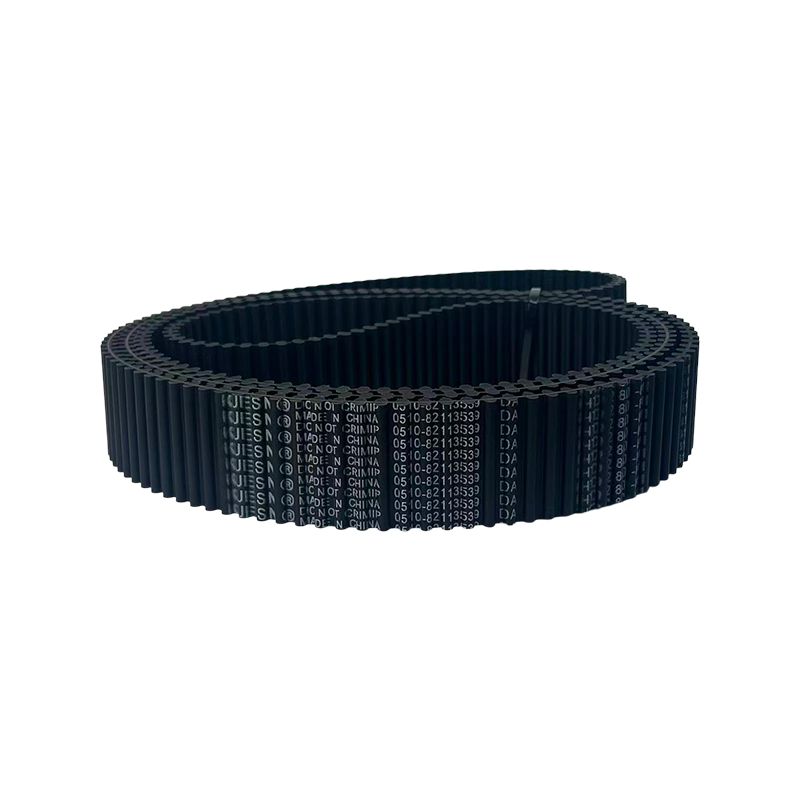
Low Noise Rubber Double Sided Timing Belt: DA, DB & Selection Guide
Most timing belt drives are straightforward: one motor shaft, one driven shaft, one belt. But real machines are rarely that simple. Printing presses need to synchronize a dozen rollers from a single drive source. Textile looms must run shafts in opposite directions at identical speeds. Packaging lines need to split power to both sides of a conveyor without doubling the belt count. These are exactly the drive problems that rubber double-sided timing belts were engineered to solve — and when low noise is a hard requirement, the material and manufacturing decisions behind them become critical.
The Drive Problem That Demands Teeth on Both Sides
A standard single-sided timing belt transmits power exclusively from its inner tooth face. That works well for straightforward two-pulley drives, but it becomes a design constraint the moment a machine requires any of the following:
- Serpentine drives — a single belt routed around multiple pulleys, some engaging from the inside and others from the outside. Without teeth on both surfaces, the belt can only drive the pulleys it contacts on its tooth side.
- Contra-rotating drives — two output shafts that must turn in opposite directions at a fixed ratio. A double-sided belt wrapping around both shafts delivers synchronized counter-rotation from a single belt and a single motor.
- Multi-point power distribution — machines where one motor must drive four, six, or more axes simultaneously, requiring the belt to engage pulleys from alternating sides along its path.
- Compact installation layouts — when center distances are tight and there is no room for a separate return belt or an idler-based workaround, a double-sided belt provides the layout flexibility that a single-sided belt cannot.
In each of these scenarios, the alternative is a chain drive, a gear train, or multiple separate belt drives — all of which are heavier, louder, require lubrication, and consume more installation space. A rubber double-sided timing belt replaces all of that with a single, maintenance-free component.
Construction: How Low-Noise Performance Is Built In
The low-noise characteristic of these belts is not a coincidence — it is the result of three distinct material layers, each contributing to quieter and smoother operation:
- Chloroprene (neoprene) rubber body — the main belt body is made from high-grade synthetic chloroprene rubber blended with specialized rubber additives. The compound is formulated at a hardness of approximately 74 Shore A, which provides the dimensional stability needed for precise tooth engagement while remaining flexible enough to dampen impact vibration as each tooth meshes with the pulley. Harder compounds transmit more vibration; the carefully calibrated hardness of chloroprene strikes the balance between rigidity and damping.
- High-strength fiberglass tensile cord — helically wound glass fiber cords are embedded at the belt's neutral axis. These cords carry the belt's tensile load without stretching, which means the tooth pitch remains constant under operating tension. Pitch variation is one of the primary causes of meshing noise in belt drives — eliminating it through low-elongation cord is a direct noise reduction measure.
- Nylon 66 tooth fabric on both sides — both the inner and outer tooth surfaces are covered with a high-elasticity nylon 66 fabric. This layer reduces the coefficient of friction between the belt tooth and the pulley groove during engagement and disengagement, which cuts sliding noise and tooth wear simultaneously. The fabric also protects the rubber tooth profile from abrasion, maintaining the precise tooth geometry that keeps meshing smooth throughout the belt's service life.
The combined effect of these three layers — damping rubber body, stretch-resistant cord, and low-friction tooth fabric — produces a belt that runs substantially quieter than chain or gear alternatives, and measurably quieter than rubber belts without the nylon tooth facing.
DA vs. DB: Which Tooth Arrangement Do You Need?
Double-sided rubber timing belts are available in two standard tooth arrangements, and the distinction matters for both performance and application fit. Matching the correct arrangement to your pulley layout is as important as selecting the right pitch — and understanding the difference also helps when selecting timing pulleys that match your belt drive requirements.
- DA — Symmetrical tooth arrangement: the teeth on both sides are positioned directly opposite each other, so each inner tooth aligns with an outer tooth. This gives the belt uniform stiffness around its cross-section, which is advantageous in high-torque drives where equal load distribution across both belt faces is required. DA is the standard form for most double-sided rubber timing belt applications and is the more widely stocked configuration. For rubber double-sided belts specifically, DA is the dominant — and often only — available arrangement.
- DB — Staggered tooth arrangement: the teeth on each side are offset by half a pitch, so an outer tooth sits between two inner teeth. This offset increases belt flexibility, reduces bending stiffness, and allows the belt to wrap around smaller-diameter pulleys without exceeding the belt's minimum bending radius. DB is preferred in compact drives with small pulley sizes, or in applications where belt flexibility takes priority over maximum torque capacity. DB is more commonly found in polyurethane double-sided belts; for rubber construction, DA is the practical choice in most standard catalog ranges.
Available Profiles and Size Range
Double-sided rubber timing belts share the same pitch dimensions and tooth profiles as their single-sided counterparts, which means they are fully compatible with standard timing pulleys. The double-sided variants are simply prefixed with "D" in imperial sizing or carry the "DA" / "DB" designation in metric sizing. The main profiles available include:
| Profile | Pitch | Tooth Shape | Primary Use Case |
|---|---|---|---|
| D-XL | 5.080 mm (1/5") | Trapezoidal | Light-load serpentine drives, office equipment |
| D-L | 9.525 mm (3/8") | Trapezoidal | Medium-load industrial drives, instrumentation |
| D-H | 12.700 mm (1/2") | Trapezoidal | High-load serpentine and multi-pulley drives |
| D-XH / D-XXH | 22.225 / 31.750 mm | Trapezoidal | Heavy industrial, high-torque reverse-rotation drives |
| DA-3M / DA-5M | 3 mm / 5 mm | Curvilinear (HTD) | Compact precision drives, automation, robotics |
| DA-8M / DA-14M | 8 mm / 14 mm | Curvilinear (HTD) | High-torque multi-axis industrial drives |
| DS-8M / DS-14M | 8 mm / 14 mm | Curvilinear (STD) | High-speed, low-noise precision machinery |
The curvilinear HTD and STD profiles distribute tooth load over a larger contact area than trapezoidal teeth, which reduces peak stress at the tooth root and further lowers operating noise — an important consideration when both multi-sided engagement and quiet operation are required simultaneously.
Key Performance Advantages
Beyond the core double-sided functionality, rubber double-sided timing belts deliver a performance profile that makes them preferable to mechanical alternatives in a broad range of industrial drives:
- Full load capacity on both sides — a correctly specified double-sided rubber timing belt can transmit up to 100% of its rated load from either face. This is not a degraded version of a single-sided belt; the tensile capacity is identical, and the drive rating applies fully to both inner and outer tooth engagement. Industry data from synchronous belt manufacturers confirms that double-sided synchronous belts engineered for twin-power applications transmit full rated load from either belt surface.
- Zero-slip synchronization — positive tooth engagement eliminates the speed variation and cumulative timing drift that friction-driven belts experience under variable load. Both sides of the belt maintain the same drive ratio at all times, which is essential in multi-shaft printing and textile applications where even slight speed discrepancies cause defects.
- No lubrication required — unlike chains and gear trains serving the same multi-axis drive functions, rubber timing belts require no lubrication. This reduces maintenance intervals, eliminates contamination risk from grease or oil, and simplifies the machine environment around the drive.
- Low shaft and bearing loads — timing belts operate at lower initial tension than V-belts because they do not rely on friction to transmit power. Reduced belt tension means less radial load on drive shafts and bearings, extending bearing service life and reducing structural requirements in the machine frame.
- Resistance to oil, moisture, and ozone — the chloroprene rubber compound maintains its physical properties in the presence of oil mist, humidity, and atmospheric ozone. This makes the belt suitable for industrial environments where rubber degradation from these agents would otherwise be a concern. For applications with direct chemical immersion or food-grade requirements, polyurethane timing belts designed for oil-exposed or food-grade environments offer an alternative material platform.
- Operating temperature range — standard chloroprene rubber double-sided timing belts operate reliably from -25°C to +100°C, covering most industrial and light manufacturing environments without requiring special grades.
Industry Applications
The combination of dual-sided power transmission, low-noise operation, and maintenance-free construction has established rubber double-sided timing belts as the standard drive component across several demanding sectors:
- Printing machinery — web-fed offset and digital presses use serpentine belt drives to synchronize printing rollers, ink fountain rollers, and paper transport rollers from a single motor. Noise performance is particularly valued in digital printing environments located near office workers.
- Textile equipment — spinning frames, looms, and winding machines require multiple shafts driven at precise speed ratios, some in opposite rotational directions. Double-sided timing belts handle both the synchronization and the contra-rotation requirements without additional gearing.
- Packaging machinery — form-fill-seal machines, carton erectors, and labeling equipment use double-sided belts to drive folding, sealing, and conveying axes from a single drive motor, reducing the number of motors and drive components in the machine.
- Precision instruments and laboratory equipment — analytical balances, spectroscopy equipment, and automated pipetting systems require low-noise, vibration-free motion. The damping properties of the neoprene body and the smooth engagement of the nylon tooth fabric make double-sided rubber belts well suited to these sensitive environments.
- Petrochemical and cable manufacturing — wire drawing machines, cable stranding lines, and extruder drives use serpentine double-sided timing belts to maintain synchronized takeup and payout speeds across multiple bobbins and drums, where any speed variation causes product defects.
- 3D printing and motion platforms — CoreXY printer designs route a single belt across both X and Y axis carriages, requiring teeth on both sides to engage the respective drive pulleys. The compact layout and the low-noise requirement of desktop and professional 3D printers align directly with what double-sided rubber timing belts provide.
When to Upgrade from Single-Sided to Double-Sided
Not every application justifies the incremental cost of a double-sided belt. The decision to upgrade is straightforward when any of the following conditions apply to the drive design:
- The drive requires power take-off from both sides of the belt, whether simultaneously or alternately.
- Two or more output shafts must rotate in opposite directions at a controlled speed ratio.
- A serpentine belt path routes the belt around pulleys that engage from alternating faces.
- Available installation space prevents routing a separate return belt, an idler arrangement, or a second drive stage.
- Noise or vibration specifications disqualify chains or gear trains as alternatives for the same multi-axis function.
If none of these conditions apply — if the drive is a straightforward two-pulley single-sided transmission — then single-sided trapezoidal rubber timing belts for standard single-axis drives remain the more cost-effective solution. The double-sided belt earns its place when the drive layout genuinely requires it — and in those applications, no other belt type provides an equivalent combination of multi-sided power transmission, synchronization accuracy, and low-noise operation in a single maintenance-free component.


Contact
-

+86-510-82113539
Shirley: +86-18906170683
Got questions? Call us 24/7 -

[email protected]
Contact us now for a quote -

No.99 Fu Rong Zhong San Rd, Xishan District Economic and Technological Development Zones Wuxi City, Jiangsu, China
Copyright © Wuxi KUEISN Transmission Equipment Co.,Ltd.All Rights Reserved. OEM Industrial Timing Belt and Synchronous Pulley Manufacturer
