


 English
 Português
 Indonesia
Submit feedback
Polyurethane Timing Belt (PU): Types, Profiles & Applications
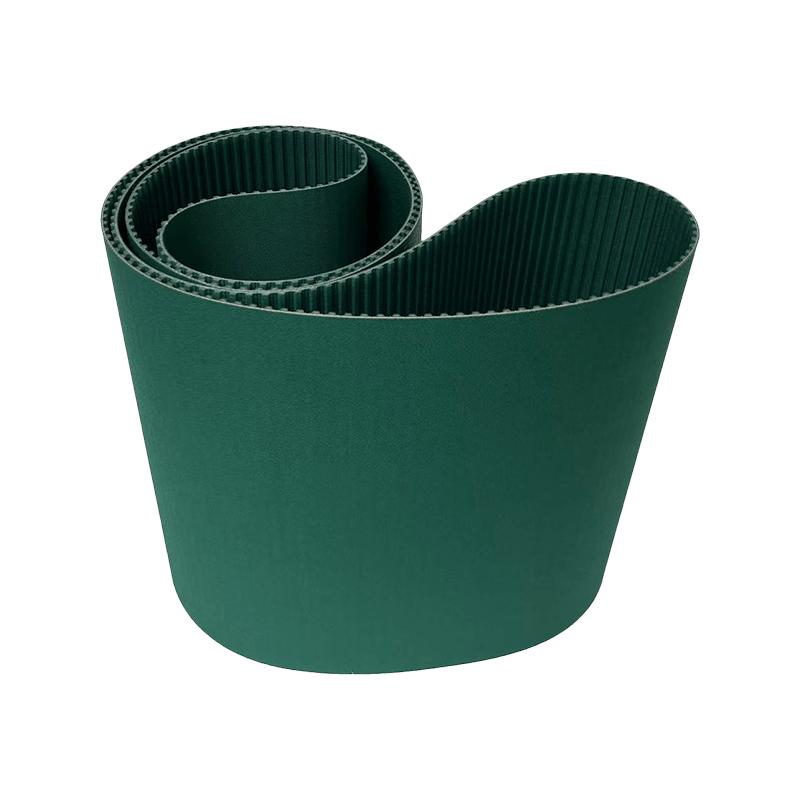
A timing belt that slips under oil contamination, swells in humidity, or loses tooth pitch after extended use is not just a maintenance problem — it is a production risk. Polyurethane (PU) timing belts were developed specifically to remove those failure modes. Built from thermoplastic polyurethane reinforced with high-tensile cord, they deliver slip-free, chemically resistant, and dimensionally stable power transmission across some of the most demanding industrial environments in use today.
What Makes PU Timing Belts Different
The foundation of every polyurethane timing belt is thermoplastic polyurethane (TPU) — a material that combines the elasticity of rubber with the chemical durability of engineering plastics. Unlike neoprene or EPDM rubber, TPU does not degrade when exposed to oils, hydraulic fluids, ozone, or many common cleaning agents. That chemical resilience makes PU timing belts far better suited for food processing lines, pharmaceutical equipment, and industrial environments where lubricant contact is unavoidable.
Embedded inside the belt body is a tensile cord that determines load capacity and dimensional stability. Three cord types are available, each suited to a different operating priority:
- Carbon steel cord — the most widely used option, offering high tensile strength and minimal elongation under load. Suitable for heavy industrial drives where flexibility is not a constraint.
- Kevlar (aramid) cord — lighter and more flexible than steel, allowing the belt to run smoothly on smaller-diameter pulleys. Preferred in compact automation systems and precision positioning equipment.
- Stainless steel cord — designed for corrosive or high-humidity environments, including marine applications and equipment that undergoes frequent washdown procedures.
The combination of TPU body and reinforced cord produces a belt that maintains its tooth profile and pitch length across millions of cycles — a level of dimensional consistency that friction-driven belts cannot match.
Three Main Types of PU Timing Belts
Polyurethane timing belts are manufactured in three structural forms. The right choice depends on whether the application is a linear drive, a conveying system, or a closed-loop power transmission circuit.
- Open-End (Linear) PU Timing Belts — produced in continuous lengths and cut to size, these belts are used in linear drive systems such as CNC axes, gantry robots, and automated guided vehicles. They can be any required length, and their high wear resistance supports running speeds up to 80 m/s.
- Welded & Spliced PU Timing Belts — the two ends of an open-end belt are joined using heat welding or mechanical splicing, forming a closed loop. This construction is particularly common in conveying applications where the belt must be fitted around fixed shafts without disassembling the machine frame.
- Truly Endless PU Timing Belts — extruded or molded as a seamless loop from the start, with no weld seam. The continuous tensile reinforcement runs uninterrupted around the full circumference, delivering maximum load capacity and uniform stretch characteristics. These are the standard choice for precision power transmission drives.
Tooth Profiles: T, AT, and HTD Explained
The tooth profile is one of the most important factors in selecting a PU timing belt. It affects transmission efficiency, positional accuracy, backlash, and the minimum pulley size the belt can run on. Three profiles dominate industrial use:
- T-Profile (Trapezoidal) — the original trapezoidal tooth form, available in pitches from T2.5 to T10. The thinner cord and shallower tooth make it the most flexible of the three, allowing it to wrap around small pulleys. However, it exhibits slightly more backlash than AT belts, which limits its use in the highest-accuracy applications. Best suited for light to moderate loads where compactness and flexibility are priorities.
- AT-Profile (Accelerated Tooth) — a modified trapezoidal profile with a wider tooth base, designed to reduce backlash and improve load distribution compared to the T-series. AT belts are the preferred choice when positioning accuracy is critical, such as in pick-and-place systems, servo-driven axes, and medical dosing equipment. The synchronization requirements that distinguish timing pulleys from standard belt pulleys make the AT profile one of the most widely specified in precision drive design.
- HTD / GT Curvilinear Profile — the curved tooth form maximizes the contact area between belt and pulley, enabling significantly higher torque transmission than trapezoidal profiles at the same belt width. HTD (High Torque Drive) and GT profiles are the default recommendation for heavy-load power transmission in robotics, industrial machinery, and high-torque conveyor drives.
Key Performance Advantages
PU timing belts outperform rubber alternatives in several measurable dimensions. Understanding these advantages helps engineers justify the material upgrade for demanding applications.
- Oil and chemical resistance — TPU maintains its structural integrity in contact with mineral oils, hydraulic fluids, mild acids, and alkaline cleaning solutions. Rubber belts absorb oils, swell, and lose tension — PU belts do not.
- Wear resistance and service life — the hard TPU tooth surface resists abrasion, reducing tooth wear even in dusty or lightly contaminated environments. Extended service intervals reduce downtime and replacement costs.
- Dimensional stability and positional accuracy — steel or Kevlar cord reinforcement keeps pitch length variation below 0.5 mm over hundreds of thousands of cycles, meeting the requirements of precision linear positioning systems.
- Low noise operation — the positive tooth engagement of PU timing belts eliminates the vibration-induced noise common in friction drives. The result is quieter operation in office automation, medical devices, and clean-room equipment.
- Food-grade compliance — TPU is inherently non-toxic and can be formulated to meet FDA and EU food contact regulations, making PU timing belts directly suitable for food processing and pharmaceutical conveying without additional coating or guarding.
- Wide operating temperature range — PU timing belts function reliably across a range of approximately -30°C to +80°C, covering most industrial and commercial refrigeration or heated-process environments.
These properties align with ISO 5296 synchronous belt drive specifications, ensuring that PU timing belts are fully interoperable with standardized pulley systems worldwide.
Industry Applications
The combination of chemical resistance, precision, and hygienic properties makes PU timing belts a first-choice component across a wide range of sectors:
- Food & Beverage Processing — meat slicing lines, bakery conveyor systems, bottling equipment, and labeling machines all benefit from food-grade TPU compliance and resistance to washdown chemicals.
- Packaging Machinery — accurate positioning of film, cartons, and labels requires zero slippage. PU belts maintain consistent drive ratios even under variable load conditions common in packaging lines.
- Robotics and Automation — industrial robots, AGVs, and collaborative robot arms rely on AT and HTD profile PU belts for the sub-millimeter repeatability demanded by assembly and inspection tasks.
- CNC Machine Tools — spindle drives, tool changers, and feed axes in CNC lathes and milling centers require low backlash and dimensional stability. PU timing belts maintain micrometer-level transmission precision across extended production runs.
- 3D Printing and Precision Equipment — the print-head axes in additive manufacturing equipment demand high repeatability at relatively low loads. Kevlar-cord PU belts are particularly common in these systems due to their flexibility on small pulleys.
- Pharmaceutical and Medical Devices — dosing pumps, diagnostic equipment, and sterile conveying systems require non-contaminating, cleanable drive components. PU timing belts satisfy both the mechanical and hygienic requirements of these environments.
PU vs. Rubber Timing Belt: A Direct Comparison
Both PU and rubber timing belts transmit power through positive tooth engagement, but their material properties lead to meaningful differences in performance, maintenance, and application fit. The table below summarizes the key distinctions:
| Criterion | PU Timing Belt | Rubber Timing Belt |
|---|---|---|
| Core Material | Thermoplastic polyurethane (TPU) | Neoprene (CR) or HNBR |
| Tensile Reinforcement | Steel, Kevlar, or stainless steel cord | Fiberglass cord |
| Oil Resistance | Excellent — no swelling or degradation | Moderate — rubber absorbs oils over time |
| Positional Accuracy | High — minimal backlash and elongation | Moderate — more susceptible to stretch |
| Food-Grade Suitability | Yes — FDA/EU compliant grades available | Limited — typically not food-grade |
| Temperature Range | -30°C to +80°C | Up to ~120°C (HNBR); lower for CR |
| Noise Level | Low | Low to moderate |
| Cost | Higher initial cost | Lower initial cost |
| Best Suited For | Precision drives, food, medical, automation | General industrial drives, high-temperature applications |
For applications where cost is the primary constraint and oil or chemical exposure is minimal, trapezoidal tooth rubber timing belts designed for cost-sensitive industrial drives remain a practical and widely used solution. When operating conditions involve contamination, high precision requirements, or regulated hygiene standards, PU is the clear choice.
Customization Options/product/rubber-timing-belts/easy-to-install-trapezoidal-tooth-rubber-timing-belts.html
Standard catalog PU timing belts cover the majority of industrial applications — but many production lines require modifications that go beyond pitch and width. Common customization options include:
- Backing materials — polyurethane, NBR, Linatex, rough-top PVC, or silicone layers bonded to the belt back for enhanced grip, sealing, or product-handling functions.
- Cleats and guides — welded PU or aluminum profiles attached to the belt surface to separate, guide, or carry products along conveyor lines.
- Perforations and vacuum slots — punched openings that allow vacuum suction through the belt for holding thin substrates, labels, or film in printing and packaging systems.
- V-guides — longitudinal rubber or PU ribs bonded to the belt back to prevent lateral drift on long conveyor spans.
- Color coding — non-standard belt colors for visual identification, line separation, or regulatory compliance in food and pharmaceutical environments.
- Custom lengths and widths — open-end belts can be supplied in any length, while welded endless belts can be produced to match virtually any center distance without requiring a standard length.
Most of these modifications are applied after extrusion using hot-welding equipment, which bonds the cleat or backing material directly into the belt body without adhesives. The result is a joint that matches or exceeds the tensile strength of the base belt.


Contact
-

+86-510-82113539
Shirley: +86-18906170683
Got questions? Call us 24/7 -

[email protected]
Contact us now for a quote -

No.99 Fu Rong Zhong San Rd, Xishan District Economic and Technological Development Zones Wuxi City, Jiangsu, China
Copyright © Wuxi KUEISN Transmission Equipment Co.,Ltd.All Rights Reserved. OEM Industrial Timing Belt and Synchronous Pulley Manufacturer
