


 English
 Português
 Indonesia
Submit feedback
Green Transformation in the Drive Industry: Sustainability Meets Efficiency
Why the Drive Industry Is Feeling the Pressure to Change
A single conveyor line running 24/7 can burn through thousands of dollars in electricity a year just fighting friction and slippage. That cost has become impossible to ignore. Energy-efficiency regulations are tightening across manufacturing hubs in Asia, Europe, and North America, and procurement teams are now asking suppliers for carbon data before they ask about price.
For an industry built on rubber, steel, and polymer, this shift is not cosmetic. Belts, pulleys, and conveyor systems sit at the physical core of how factories consume power. Every percentage point of transmission loss translates directly into wasted energy, which is why the conversation around sustainability in this space has moved from marketing language to engineering requirement.
The result is a quiet but real transformation happening on the factory floor — one measured less in slogans and more in material formulas, tooth profiles, and tolerance specs.
Rethinking Materials: From Virgin Rubber to Engineered Polyurethane
Traditional rubber belting has a resource problem. Producing it consumes significant raw rubber and energy, and worn belts often end up in landfill rather than back in a supply chain. Manufacturers across the sector are responding by shifting toward materials that last longer and demand less from the planet to make.
Polyurethane has emerged as one of the clearest answers. It resists abrasion better than standard rubber compounds, which stretches service life and cuts down on replacement frequency — fewer belts manufactured, fewer belts discarded. Some producers are also blending in recycled rubber compounds or exploring bio-based polymers for lower-load applications, though those remain early-stage compared to polyurethane's proven track record.
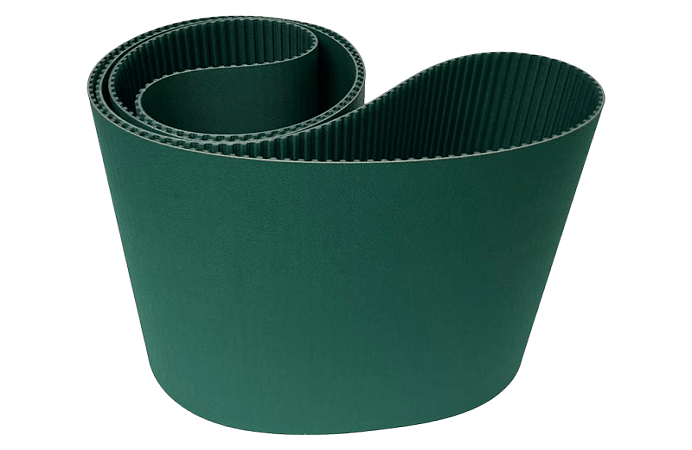
This is where polyurethane timing belts engineered for lower material waste come into play. Built to hold tension and tooth geometry over extended duty cycles, they reduce the churn of constant replacement that drives up both cost and environmental impact. The same logic applies to material handling: polyurethane conveyor belts built for demanding production lines hold up under continuous load without the frequent degradation that plagues lower-grade rubber alternatives.
Precision as an Efficiency Lever
Material choice only tells half the story. A belt made from the greenest polymer available still wastes energy if it slips, misaligns, or runs loud enough to signal friction loss. Precision is where sustainability and mechanical performance actually converge.
Slippage is a silent energy tax. When a belt loses even a fraction of grip on a pulley, the motor has to work harder to deliver the same output — and that extra draw adds up across thousands of operating hours. Tighter tooth engagement and consistent pulley geometry solve this at the source, rather than compensating for it with a bigger motor.
This is the thinking behind no-slip timing pulleys that cut energy loss from slippage, designed so torque transfer stays consistent instead of degrading over time. Noise reduction plays a similar role: excessive vibration usually points to friction that is bleeding off as heat and sound instead of useful work. Options like low-noise polyurethane herringbone timing belts address both problems at once, smoothing engagement while keeping transmission losses down.
Where KUEISN's Product Line Fits the Shift
KUEISN has approached this transition less as a rebrand and more as a design constraint applied across its catalog. Rather than treating sustainability as a separate product tier, the company folds durability and transmission efficiency into the core specifications of its belts and pulleys.
The poly V-belts designed for high-efficiency power transmission illustrate this well — their multi-rib profile increases contact surface area, which spreads load more evenly and reduces the localized wear that shortens belt life in single-rib designs. Less wear means fewer replacements, and fewer replacements means a smaller material footprint over the equipment's lifetime.
This same philosophy extends to how the company thinks about factory-wide efficiency rather than just individual components. As covered in a recent look at how timing pulleys are evolving in modern factories, the push toward automation and tighter process control is reshaping pulley design in tandem with sustainability goals — precision and resource efficiency are increasingly the same design problem viewed from two angles.
Standards and Certifications Shaping the Transition
None of this happens in a vacuum. Environmental management frameworks are increasingly what separates suppliers who talk about sustainability from those who can prove it. ISO's environmental management systems standard gives manufacturers a structured framework for tracking resource use, cutting waste, and demonstrating continual improvement — and it has become a common requirement in supplier vetting, particularly in automotive and industrial equipment supply chains.
For buyers, certification is not just a compliance checkbox. It signals that a supplier has processes in place to measure and reduce environmental impact systematically, rather than making one-off claims. As regulatory scrutiny increases across major manufacturing regions, this kind of documented accountability is becoming table stakes rather than a differentiator.
What Buyers Should Look for When Sourcing Sustainable Drive Components
Cutting through marketing claims requires a few concrete questions. Ask what the belt or pulley is actually made of and why — recycled content and engineered polymers should come with performance data, not just a green label. Ask about service life under real load conditions, since a component that lasts twice as long often has a smaller lifecycle footprint than one marketed as "eco" but replaced twice as often.
It also helps to ask how a supplier manages precision and quality control, since slippage and misalignment quietly undercut any material-level sustainability gains. A belt built from recycled compounds but poorly matched to its pulley will waste more energy than a well-engineered standard component.
The direction of the drive industry is fairly clear at this point: efficiency and sustainability are no longer competing priorities but two measurements of the same underlying goal — getting more useful work out of every watt and every gram of material. KUEISN's full range of transmission belts and pulleys reflects that convergence, built around the idea that a component doing its job precisely is, by definition, doing it more responsibly.


Contact
-

+86-510-82113539
+86-18906170683
Got questions? Call us 24/7 -

[email protected]
Contact us now for a quote -

No.99 Fu Rong Zhong San Rd, Xishan District Economic and Technological Development Zones Wuxi City, Jiangsu, China
Copyright © Wuxi KUEISN Transmission Equipment Co.,Ltd.All Rights Reserved. OEM Industrial Timing Belt and Synchronous Pulley Manufacturer
