


 English
 Português
 Indonesia
Submit feedback
How Synchronous Pulley Precision Affects Drive System Lifespan
A timing belt doesn't fail because it's a bad belt. Most of the time, it fails because the pulley it runs on isn't precise enough. Tooth profile errors, bore eccentricity, surface finish problems, and misalignment — each of these traces back to pulley quality, and each of them shortens drive system life in ways that are entirely preventable.
Pulley precision is one of the least discussed variables in drive system selection. It's also one of the most consequential. Understanding what precision actually means in a synchronous pulley — and how it translates to belt life, bearing load, and positioning accuracy — is the foundation of a reliable drive specification.
What Pulley Precision Actually Means
Precision in a synchronous pulley is not a single measurement. It's a collection of geometric properties that must all be controlled simultaneously for the pulley to function as designed. The key parameters are:
- Concentricity. The bore centerline and the pitch circle centerline must coincide within tight limits. High-precision CNC-machined pulleys hold concentricity within 0.05 mm; the best achieve 0.01 mm. When concentricity is poor, the effective center distance between pulleys varies with every revolution — alternately overtightening and slackening the belt, accelerating fatigue.
- Runout. Total runout measures how much a surface deviates from its theoretical position during rotation. Even 0.01 mm of runout at 15,000 RPM generates measurable forces that load bearings unevenly and introduce vibration into the belt span. At lower speeds the effect is subtler but still cumulative over thousands of operating hours.
- Tooth profile accuracy. Each groove must match the mating belt tooth geometry precisely. Profile errors change the contact stress distribution — concentrating load at the tooth tip rather than distributing it across the full flank — and cause the belt to wear unevenly and noisily.
- Bore tolerance. The fit between pulley bore and shaft determines whether the pulley runs true. H7 bore tolerance is the industry standard for timing pulleys; deviation from this causes eccentric mounting, which feeds directly into runout and concentricity problems.
- Surface finish. Groove surface finish affects friction at the belt-tooth interface. The standard range for timing pulleys is Ra 1.6–3.2 µm; rougher surfaces accelerate tooth face wear and generate more heat during engagement.
These parameters are interdependent. A pulley with excellent concentricity but poor tooth profile accuracy still produces uneven load distribution. A precisely profiled pulley mounted on a shaft with inadequate fit produces runout. All variables must be controlled together.
How Precision Errors Propagate Through the Drive System
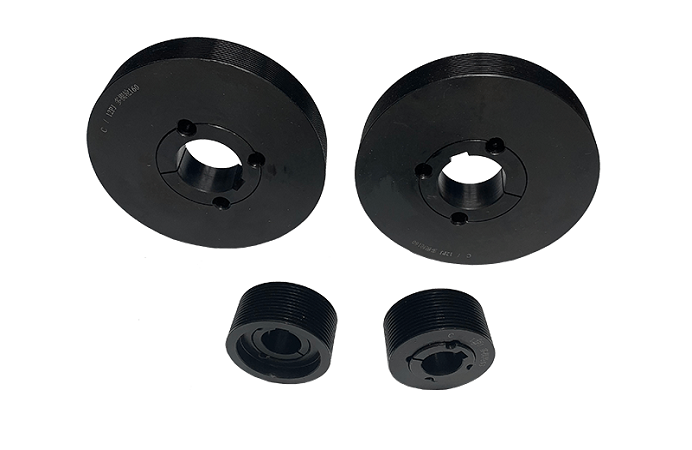
The mechanism by which pulley imprecision damages a drive system is straightforward, but the effects compound over time in ways that aren't always obvious until something fails.
Eccentricity in a drive pulley causes the effective belt tension to vary cyclically — once per shaft revolution. The belt is alternately pulled tight and allowed to slacken. In the tight phase, tensile stress in the reinforcing cords increases beyond the design load. In the slack phase, the teeth may partially disengage, creating the conditions for tooth skip under load. Repeated over millions of cycles, this tension cycling causes cord fatigue and eventually tensile failure — even if the nominal load is well within the belt's rated capacity.
Tooth profile errors create a different failure mode. When grooves are oversized, the belt tooth rocks in the groove rather than seating cleanly. This concentrates bending stress at the tooth root and causes progressive cracking — the classic early failure pattern in drives that look correctly tensioned on inspection. When grooves are undersized, engagement interference generates heat and causes abrasive wear on both the belt tooth face and the pulley groove surface.
Misalignment — whether from bore error, mounting inaccuracy, or shaft deflection — causes the belt to track laterally. Edge loading follows: the belt runs hard against one flange, wearing the edge cords faster than the center. Shaft misalignment beyond 0.5° has been documented to reduce belt life by nearly half in typical industrial conditions.
Meanwhile, elevated belt tension from any of these sources transfers directly to shaft bearings as radial load. Bearing life scales inversely with the cube of load in ball bearings — doubling the radial load reduces bearing life by a factor of eight. A pulley with modest precision deficiencies can cut bearing replacement intervals dramatically without the connection ever being identified.
Tooth Profile Selection and Its Effect on Longevity
Pulley precision cannot be separated from tooth profile selection. The two decisions interact directly: a correctly profiled groove machined to loose tolerances performs worse than a simpler profile held to tight ones.
The major tooth profile families each have distinct wear characteristics:
- Trapezoidal profiles (MXL, XL, L, T-series). The original synchronous drive tooth geometry. The angular flanks create stress concentrations at the tooth root during engagement, which limits torque capacity and accelerates wear at high speeds. Suitable for moderate loads and speeds where precise registration is secondary to cost.
- Curvilinear profiles (HTD, S-series). The rounded tooth form distributes contact stress more evenly across the tooth flank, reducing peak stress at the root. This increases torque capacity and improves belt life under heavy load. However, the larger tooth geometry allows more backlash, making curvilinear profiles less suitable for high-precision positioning.
- Modified curvilinear profiles (GT2, GT3, AT-series). Engineered to capture the load distribution advantages of curvilinear teeth while tightening backlash to levels approaching trapezoidal profiles. These are the current standard for servo-driven precision applications — combining high torque capacity with low positional error.
The critical manufacturing requirement is that the pulley groove geometry must match the belt tooth profile precisely. Running an HTD belt on a trapezoidal pulley — or any mismatched combination — produces immediate and severe contact stress problems. The groove must be machined to the exact profile specification of the corresponding belt standard, using tooling and inspection overlays provided by or licensed from the belt manufacturer.
Explore the no-slip timing pulleys designed for precision synchronous drives for applications where tooth engagement accuracy is critical to system performance.
Material Selection: Matching the Pulley to the Application
The material a synchronous pulley is machined from determines its wear resistance, thermal stability, weight, and suitability for specific operating environments. There is no universal best material — the correct choice depends on the load, speed, environment, and system design priorities.
- Aluminum alloy (6061, 7075). The most widely used material for timing pulleys in industrial automation, robotics, and CNC equipment. Aluminum offers an excellent combination of machinability, dimensional stability, low rotational inertia, and natural corrosion resistance. Anodized aluminum pulleys achieve surface hardness approaching 60 HRC on the tooth faces, significantly extending groove life compared to untreated material. The low density makes aluminum the preferred choice wherever rapid acceleration or deceleration is a design constraint.
- Steel (45# carbon steel, alloy steel). Substantially harder and stronger than aluminum, steel pulleys are specified for high-torque, high-load applications where groove wear would be unacceptable at aluminum hardness levels. Steel is approximately 2.5 times denser than aluminum, which increases rotational inertia — a relevant factor in servo systems with frequent direction reversals. For heavy industrial drives and machine tools operating under sustained high loads, steel provides the durability margin that aluminum cannot.
- Stainless steel. Required in food processing, pharmaceutical manufacturing, and washdown environments where corrosion resistance and hygienic surface finish are regulatory requirements. The wear and heat-resistant pulley options in corrosion-resistant materials address these demanding environmental conditions directly.
- Engineering polymers (nylon, acetal). Used in light-duty and fractional-horsepower applications where noise reduction, non-magnetic properties, or FDA material compliance are priorities. Polymer pulleys have lower tensile strength than metals and are temperature-limited; they should not be specified in high-load or elevated-temperature environments.
For small and medium equipment where a range of standard pulley configurations are needed, V-belt pulleys designed for small and medium-sized equipment offer practical solutions across common drive configurations.
Dynamic Balance and High-Speed Drives
At elevated operating speeds, pulley mass distribution becomes a significant factor in drive system life. An unbalanced pulley generates centrifugal forces that rotate with the shaft — loading bearings asymmetrically, introducing vibration into the belt span, and eventually exciting resonance in the drive structure.
The threshold at which dynamic balance becomes necessary depends on both speed and pulley diameter. For precision drives operating above 3,000 RPM, or for larger-diameter pulleys at moderate speeds, dynamic balancing is not optional — it's a specification requirement. The effect on bearing life alone justifies the additional manufacturing step: bearing radial load directly determines L10 life, and rotating unbalance is among the most common hidden contributors to premature bearing failure in high-speed drives.
CNC-machined pulleys with controlled mass symmetry — where material is removed uniformly and bore concentricity is tight — start with inherently lower unbalance than cast or formed pulleys. For the most demanding applications, explicit dynamic balance certification to defined residual unbalance limits is available and worth specifying.
Pulley Wear as a Leading Indicator
One of the most reliable indicators of drive system condition is the state of the pulley grooves — not the belt. Belts are consumable components and are inspected routinely. Pulleys, which should outlast multiple belt replacement cycles, are often left in service long past the point where their groove geometry has deteriorated enough to accelerate belt wear.
Signs that a pulley has worn beyond its service limit include:
- Groove width expanded more than 3% from the original nominal dimension
- Visible rounding or chamfering of the tooth tips that changes the designed engagement geometry
- Surface roughness that has increased beyond Ra 3.2 µm, detectable by touch or optical inspection
- Flange wear from belt tracking contact, indicating persistent misalignment
Installing a new belt on a worn pulley is one of the most common and avoidable causes of premature belt failure. The new belt is immediately subjected to the same abnormal contact conditions that wore out the old one — and will fail on a similar shortened timeline. Belts and pulleys should be evaluated as a matched system at each service interval, and replaced together when either component shows wear beyond tolerance.
The broader context of how modern factory environments are changing the requirements for synchronous drive components is covered in detail in the article on how timing pulleys are evolving in modern manufacturing environments.
Specifying Pulleys for Long Drive System Life
Translating an understanding of precision requirements into a practical specification involves several decisions that determine whether the drive system achieves its design life or falls short of it.
- Match tooth profile to the application. Precision positioning applications require modified curvilinear profiles (GT2/GT3, AT-series) to achieve low backlash. High-torque continuous drives prioritize HTD curvilinear geometry for load distribution. Don't select a profile based on availability alone.
- Specify bore tolerance and fit class. H7 tolerance for the pulley bore, matched to the appropriate shaft tolerance for the intended fit class (typically h6 for clearance fits, k6 or m6 for transition or interference fits). This is the starting point for concentricity in the installed system.
- Require flange configuration for alignment retention. In two-pulley drives, flange the smaller pulley. When shaft misalignment is a concern, flange both pulleys. In multi-pulley drives, ensure at least two pulleys are flanged. Flanges are not aesthetic — they are the mechanical constraint that prevents belt tracking drift.
- Select material based on load, speed, and environment. Don't default to aluminum for every application. Steel where tooth wear rates are the constraint; stainless or polymer where chemical or regulatory requirements apply.
- Replace pulleys and belts as a matched set. Groove wear is invisible from across the maintenance bay. A simple gauge check against the original profile specification takes seconds and eliminates one of the most common causes of repeated premature belt failure.
A drive system is only as precise as its least precise component. The belt carries the load, but the pulley defines the geometry within which the belt must operate. Investing in pulley precision is the most reliable way to extend the service life of the entire drive — belts, bearings, and the machinery they serve.
For a full overview of available synchronous drive components, the complete timing pulley product range covers standard and application-specific configurations across materials and tooth profiles.


Contact
-

+86-510-82113539
+86-18906170683
Got questions? Call us 24/7 -

[email protected]
Contact us now for a quote -

No.99 Fu Rong Zhong San Rd, Xishan District Economic and Technological Development Zones Wuxi City, Jiangsu, China
Copyright © Wuxi KUEISN Transmission Equipment Co.,Ltd.All Rights Reserved. OEM Industrial Timing Belt and Synchronous Pulley Manufacturer
