


 English
 Português
 Indonesia
Submit feedback
OEM vs Custom Timing Belts: Advantages for Specialized Industrial Equipment
A packaging line running at 800 cycles per minute. A robotic arm performing micron-level positioning. A food processing conveyor operating through daily high-pressure washdowns. Each of these machines has one thing in common: a standard catalog timing belt was never designed for it.
For general-purpose machinery, off-the-shelf OEM timing belts do the job. They're widely available, cost-predictable, and engineered to meet the broadest possible range of conditions. But specialized equipment is built around specific performance demands — and that's where standard belts begin to show their limits.
What Makes Specialized Equipment Different
Standard industrial machinery is designed around common operating parameters: moderate speeds, predictable loads, controlled environments. Specialized equipment doesn't follow that playbook. It's engineered for a defined task, often pushing one or more variables — speed, torque, temperature, chemical exposure, or positional accuracy — beyond what general-purpose components were designed to handle.
Consider the differences that matter most in drive selection:
- Non-standard center distances that require belt lengths unavailable in any catalog
- Extreme operating environments including chemical washdowns, sub-zero cold storage, or high-heat furnace-adjacent processes
- Micron-level positioning requirements in CNC machining, robotics, and medical diagnostics equipment
- Variable load profiles involving rapid acceleration, shock loads, or simultaneous multi-axis drive demands
- Regulatory constraints requiring FDA-compliant or food-safe materials
When equipment operates at these edges, the tolerance stack-up of a generic belt — manufactured to serve ten thousand different machines — becomes a liability rather than a convenience.
Where Standard OEM Belts Fall Short
OEM timing belts are built to a specification that serves the average application well. That's their strength — and their constraint. In specialized equipment, "average" is rarely the target.
The practical limitations show up in several areas:
- Fixed dimensions. Standard belts come in catalog pitch lengths and widths. If your machine's geometry falls between sizes, you're either redesigning the drive or accepting a compromise — and in precision equipment, compromise accumulates into measurable error.
- Limited material options. Most OEM belts are available in neoprene or standard EPDM rubber. Applications involving aggressive cleaning agents, oil misting, ozone exposure, or extreme temperatures need compound formulations that catalog products simply don't offer.
- Generic tooth profiles. Standard trapezoidal and HTD profiles are engineered for power transmission across a wide load range. They're not optimized for low-noise high-speed operation, minimal backlash positioning, or the meshing behavior needed in a specific pulley system.
- No surface modification. Catalog belts ship with a standard backing. Specialized conveying or clamping applications may require foam backing, rubber grip surfaces, cleats, or conductive coatings — none of which are available off the shelf.
None of these limitations means standard OEM belts are poor products. They're excellent products — for the applications they were designed to serve. The issue is the mismatch, not the belt itself.
The Engineering Advantages of Custom Timing Belts
A custom timing belt is engineered backward from the application. Instead of finding the closest catalog match, the designer starts with the actual operating conditions and builds a belt specification to meet them. The result is a component that fits the machine — not a machine adapted to fit the component.
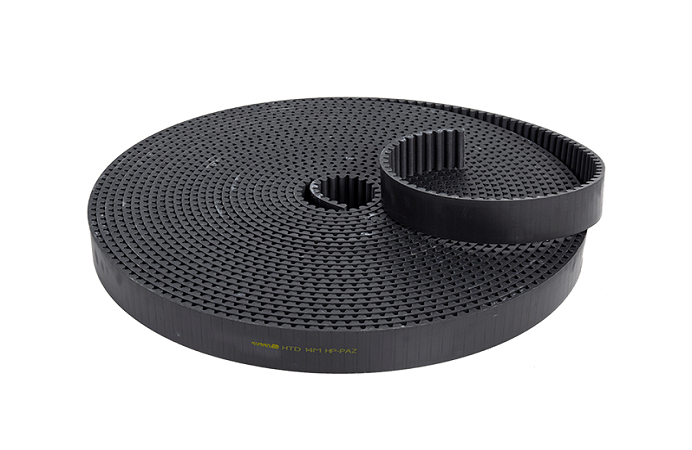
The key engineering levers in a custom belt are:
- Exact pitch length and width. Any center distance, any drive geometry. Custom belts eliminate the compromises imposed by discrete catalog sizing, which matters enormously in tightly packaged machine designs where belt tension geometry is fixed.
- Material selection matched to the environment. Polyurethane timing belts for precision industrial drives offer superior abrasion resistance, dimensional stability, and chemical tolerance compared to standard rubber compounds. For high-load synchronous drives, rubber timing belts for high-load synchronous drives in engineered compound formulations deliver tensile strength and flexibility profiles unavailable in OEM catalog products.
- Tension member specification. Steel cord, aramid (Kevlar), fiberglass, and polyester each deliver a different balance of stiffness, elongation resistance, and minimum bend radius. Custom belts select the cord for the application's load cycle — not for a population average.
- Tooth profile optimization. Custom tooth geometry can be tailored to minimize meshing noise, maximize tooth shear strength, or achieve a specific backlash target. This is particularly significant in servo-driven systems where positional accuracy directly correlates to output quality. Standards such as ISO 17396 for metric synchronous belt profiles define the dimensional framework, but custom manufacturing works within and beyond those parameters to meet application-specific meshing requirements.
- Surface and backing modifications. Special-surface polyurethane timing belts can incorporate sponge, silicone, or rubber coatings; drilled holes for sensor integration; tooth removal patterns for timing registration; or cleated profiles for product transport — turning a drive component into a functional machine element.
Reducing Downtime: The Real Cost of the Wrong Belt
Timing belt selection is often treated as a procurement decision. It's actually a risk management decision.
When a standard belt fails in specialized equipment, the cost rarely ends with the belt. The downstream consequences include:
- Production line stoppage during a shift that cannot be recovered
- Potential damage to downstream components — pulleys, bearings, shafts — from sudden load release or tooth shearing
- Product loss or contamination in continuous-process industries like food, pharma, or electronics manufacturing
- Maintenance labor plus parts costs that far exceed the price differential between a standard and custom belt
The most common causes of premature timing belt failure in specialized equipment — misalignment, incorrect tension for the load cycle, contamination incompatibility, and tooth profile mismatch — are all engineering problems. A custom belt specification addresses each of them at the design stage, before the machine enters service.
This is the core economic argument for custom timing belts: the upfront cost difference is almost always smaller than a single unplanned stoppage. In high-throughput automated lines, even brief downtime can generate losses that dwarf the entire annual belt procurement budget.
Industry Applications Where Customization Matters Most
Certain industries have arrived at custom timing belts not as a preference, but as a practical necessity. Standard components simply cannot meet their operating requirements consistently.
- Industrial robotics and automation. Servo-driven robotic arms require belts with near-zero elongation and consistent pitch accuracy across millions of cycles. Precision timing pulleys for synchronized motion, paired with custom steel-cord PU belts, are the standard architecture for high-cycle robotic applications.
- Packaging machinery. High-speed packaging lines demand exact registration between drive zones. Custom belt lengths ensure that product indexing stays synchronized across a multi-station line without accumulated pitch error.
- Food and pharmaceutical processing. Washdown environments require FDA-compliant polyurethane compounds, sealed-tooth profiles that don't harbor bacteria, and surface materials that tolerate repeated chemical exposure without degradation. Catalog rubber belts are not rated for these conditions.
- Medical and laboratory equipment. Diagnostic and imaging equipment requires extremely low-noise, low-vibration drive solutions. Custom tooth profiles and damping-optimized materials reduce acoustic emissions to levels that standard drives cannot approach.
- Textile and printing machinery. These applications involve extremely precise web tension control and registration. Belt stretch characteristics must be specified to fractions of a percent — tolerances that require application-specific tension member selection.
- Aerospace ground support and instrumentation. Extreme temperature cycling, vacuum compatibility, and outgassing requirements eliminate most standard belt materials entirely. Custom elastomer and cord selection is not optional in these environments.
How to Evaluate a Custom Timing Belt Supplier
Not all suppliers offering "custom" timing belts deliver the same capability. The difference between a supplier that can cut a non-standard length from stock material and one that can engineer a genuinely application-specific solution is significant — and worth probing before placing an order.
Key evaluation criteria:
- Manufacturing scope. Can they produce custom tooth profiles, or only custom lengths and widths? A true custom capability includes compound formulation, cord selection, and surface modification — not just dimensional variation on a standard belt body.
- Quality system. ISO 9001 certification is the minimum baseline. It ensures that the quality management processes governing material traceability, dimensional inspection, and corrective action are audited and documented. Learn more about what ISO 9001 quality management system certification requires of a manufacturer.
- Low MOQ and prototyping support. Specialized equipment often runs in limited quantities. A supplier that requires volume commitments before prototyping adds risk to the engineering process. Look for manufacturers that can deliver engineering samples in small quantities.
- Technical support. The supplier should be able to review your drive geometry, load requirements, and operating environment — and make material and profile recommendations based on that data. A supplier that only asks for dimensions is not an engineering partner.
- Material certifications. For food, pharma, and medical applications, ask for documentation of FDA compliance, RoHS status, and any relevant regional certifications before specifying the belt.
For a broader perspective on belt sourcing decisions and how imported and domestic options compare on key performance dimensions, the comparison of imported vs. domestic industrial belts covers the key tradeoffs in detail.
Specialized equipment is an investment in performance. The drive components that keep it running should be engineered to the same standard as the machine itself — not selected from the nearest available catalog entry.


Contact
-

+86-510-82113539
+86-18906170683
Got questions? Call us 24/7 -

[email protected]
Contact us now for a quote -

No.99 Fu Rong Zhong San Rd, Xishan District Economic and Technological Development Zones Wuxi City, Jiangsu, China
Copyright © Wuxi KUEISN Transmission Equipment Co.,Ltd.All Rights Reserved. OEM Industrial Timing Belt and Synchronous Pulley Manufacturer
