


 English
 Português
 Indonesia
Submit feedback
Double-Sided Timing Belts: When Do You Need Power on Both Faces?
The Layout Problem Single-Sided Belts Can't Solve
Picture a drive with three shafts on the same plane, one of them turning the opposite direction of the other two. A standard timing belt only carries teeth on its inner face, so the moment you need to drive a pulley from the outside of the loop, the belt has nothing to grip with. Engineers usually solve this with a second belt, an idler gear train, or a chain — each adding a part that has to be tensioned, aligned, and eventually replaced on its own schedule.
A double-sided timing belt removes that extra part by putting teeth on both faces of a single loop. One belt, one tensioning point, and both the inside and outside pulleys stay in exact phase with each other. That's the specific problem this belt type exists to solve — not general durability or noise reduction, which single-sided belts already handle well.
KUEISN builds this into a rubber timing belt with teeth cut into both faces, keeping the tooth geometry and pitch accuracy consistent on each side so torque doesn't drop off depending on which face is doing the driving.
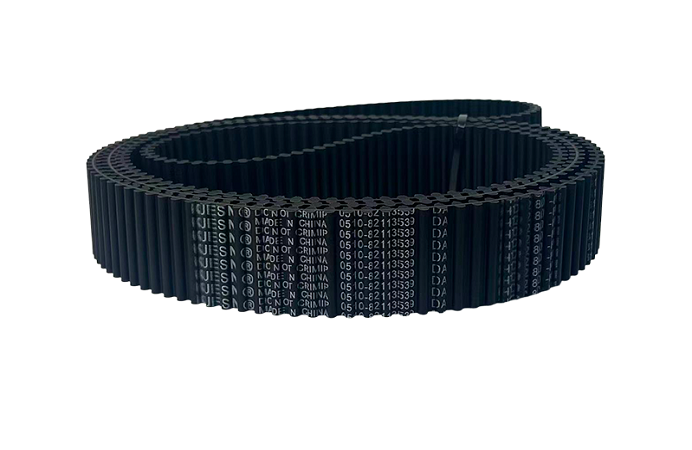
DA vs DB Tooth Arrangement: Why Symmetry Matters
Double-sided belts come in two tooth layouts, and picking the wrong one is a common source of unexplained vibration in multi-axis drives.
- DA (symmetrical): teeth on both faces sit directly opposite each other, tooth-to-tooth. This keeps the belt's cross-section uniform along its length, which matters when both faces are under similar load and you need predictable flex behavior at the pulleys.
- DB (staggered): teeth on one face sit offset from the teeth on the other. This lets each face keep a fuller cross-section at the point where it isn't meshing with a tooth on the opposite side, which can matter for belts running at higher speeds or tighter bend radii.
The distinction rarely shows up in a spec sheet's headline numbers, but it does show up in service life. A DA belt forced into a drive with uneven load distribution between faces will wear asymmetrically faster than the catalog rating suggests — the belt itself isn't defective, it's just matched to the wrong layout. Reviewing how tooth profile standards are applied across belt and sprocket combinations is worth doing before locking in a DA or DB choice, since profile mismatches compound the wear problem. For more background on tooth-side construction generally, our notes on synchronous belt characteristics and precautions cover the adjacent failure modes to watch for.
The Hidden Cost of Driving From the Back Face
Marketing copy for double-sided belts tends to stop at "power transmission from both sides." What it usually skips is that driving from the back face isn't free — it comes with a measurable efficiency and life trade-off compared to a dedicated single-sided belt running the same load.
Three things change once a face becomes a working drive surface instead of a passive back:
- Bend fatigue accumulates on both faces simultaneously instead of one flexing side and one static back, shortening the interval between recommended inspections.
- Tension calculations have to account for two different load paths pulling on the same tensile cord layer, rather than one dominant path with a passenger face along for the ride.
- Heat generated at each meshing point on both faces has less surface area to dissipate into, since neither face gets a full cooling cycle the way a single-sided belt's back does.
None of this makes double-sided belts a poor choice — it just means the torque rating on a spec sheet, calculated per standard synchronous belt torque rating methods, should be read as a ceiling for combined-face loading, not for each face independently. Sizing a drive as if both faces could each hit the full rating at once is where premature failures usually start.
Where Double-Sided Belts Actually Earn Their Place
Strip away the long application lists most suppliers publish, and double-sided belts earn their place in a narrower set of layouts than the marketing suggests:
- Reverse-rotation drives — one shaft needs to spin opposite to the others without adding a separate reversing gear.
- Serpentine layouts — the belt winds around multiple pulleys on alternating sides to fit a compact footprint, common in packaging and textile equipment.
- True multi-axis synchronization — three or more shafts must stay in exact phase, and a chain or dual-belt setup would introduce backlash between them.
If a drive only needs one direction of rotation and enough room for a second pulley run, a single-sided belt paired with pulleys designed to resist slip under uneven loading is usually the simpler and cheaper path — no back-face fatigue, no DA/DB decision to get wrong. Double-sided construction is worth the added cost specifically when the layout leaves no other way to keep multiple axes synchronized. KUEISN's broader rubber timing belt lineup covers both paths, so the layout — not the belt catalog — should be what decides the format.
Material and Tooth-Profile Choices That Affect Reliability
Once the layout confirms a double-sided belt is the right call, the remaining decisions are about what the belt is made from and how its teeth are shaped.
- Rubber vs. polyurethane body: rubber constructions hold up better under oil and grease exposure typical of heavy machinery, while polyurethane timing belts run cleaner and quieter in food, packaging, or clean-room environments where rubber dust is a contamination risk.
- Trapezoidal vs. curved tooth profile: trapezoidal profiles are simpler to manufacture and tend to cost less, while curved profiles distribute load across more tooth surface per mesh, which matters more as belt speed or torque climbs.
- Herringbone tooth geometry: for drives where both load and noise are constraints at the same time, a herringbone tooth design built for higher load capacity without added noise is worth comparing against a straight-tooth double-sided belt, since the angled tooth engagement reduces the impact noise that straight teeth produce at each mesh point.
None of these choices matter until the layout question from the sections above is settled first. Picking a premium material or tooth profile can't compensate for choosing double-sided construction when the drive never actually needed it — and it won't fix a DA/DB mismatch either.


Contact
-

+86-510-82113539
Shirley: +86-18906170683
Got questions? Call us 24/7 -

[email protected]
Contact us now for a quote -

No.99 Fu Rong Zhong San Rd, Xishan District Economic and Technological Development Zones Wuxi City, Jiangsu, China
Copyright © Wuxi KUEISN Transmission Equipment Co.,Ltd.All Rights Reserved. OEM Industrial Timing Belt and Synchronous Pulley Manufacturer
