


 English
 Português
 Indonesia
Submit feedback
Cushioning Felt Conveyor Belts: Not All Vibration Should Be Absorbed
What Felt Absorption Actually Protects
A steel sheet dropping onto a bare PVC belt leaves a mark. The same sheet landing on a felt surface doesn't, because the felt layer compresses under impact instead of transmitting it straight into the product. That's the entire case for felt in one sentence — it's a compliant contact layer, not a stronger or more durable belt in the way PU or PVC are.
The applications where this earns its place are specific: cutting tables where blades pass close to the belt surface, printing and paper lines where a single scratch ruins a sheet, and packaging feeds where lightweight or irregular products slide on smoother surfaces. In each case, the felt isn't adding strength — it's removing the hard contact point that would otherwise damage the product or destabilize the feed.
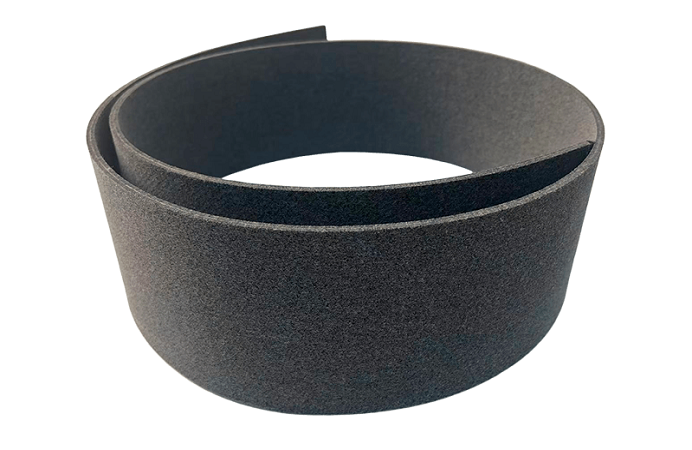
KUEISN's cushioning felt conveyor belt built for shock absorption is designed around that same principle — compress on contact, protect the surface, and do it consistently across the belt width rather than only at a few soft spots.
Where Cushioning Works Against the Process
Cutting lines are the one application where felt's biggest strength turns into a liability if it's overdone. A blade needs a certain amount of resistance at the point of contact to cut to a consistent depth. A felt layer that's too thick or too low-density gives the blade something to sink into instead of cut against, and the cutting depth starts drifting across the width of a pass — not because the blade dulled, but because the belt underneath it stopped offering consistent resistance.
The same trade-off shows up in registration-sensitive processes, where a product's position on the belt has to stay predictable enough for a downstream sensor or stop to catch it at the same point every cycle. A belt surface that's too soft lets products settle at slightly different depths depending on their weight, which shifts the effective contact point cycle to cycle. None of this means felt is the wrong material for cutting or registration work — it means the density and thickness have to be picked for how much resistance the process actually needs, not maximized for softness.
The Resonance Trap: When a Cushioning Layer Amplifies Instead of Absorbs
Every compliant layer sitting between a vibration source and the thing it's protecting has a natural frequency of its own, set by its stiffness and the mass pressing on it. Vibration isolation theory describes what happens next in terms of a transmissibility curve: below that natural frequency, vibration passes through largely unchanged. Right around it, the layer doesn't dampen the vibration — it amplifies it, sometimes several times over. Only once the disturbing frequency climbs well past that point does the layer start actually isolating the vibration it's supposed to be absorbing.
A felt layer on a conveyor is a real-world version of this same system. If the belt's operating speed and roller spacing happen to excite a frequency close to the felt's own resonance, the cushioning effect works in reverse — the belt surface moves more, not less, than it would with no felt layer at all. This is why a felt belt that solves a vibration problem on one machine can make an identical-looking problem worse on another: the frequency the felt is being asked to handle is different, even though the visible symptom looks the same.
Matching Felt Density and Backing to the Actual Load Frequency
Getting out of the amplification zone described above comes down to a few practical adjustments, not a different material altogether:
- Increase felt density rather than thickness when the belt is amplifying instead of damping — a denser felt shifts the natural frequency higher, which is usually more effective than simply adding a thicker, softer layer.
- Add a reinforced backing under the felt when conveying heavier or sharp-edged material — the backing changes the stiffness of the whole compliant layer, not just its surface feel.
- Check roller spacing and belt speed together, not separately — the frequency exciting the felt layer comes from how often the belt passes over a support point at operating speed, so the same felt can behave differently on two conveyors running at different speeds even with identical roller spacing.
These adjustments only matter once the layout is confirmed to actually need a compliant surface in the first place. For processes where the felt spends more time fighting resonance than solving the original vibration problem, it's worth comparing against KUEISN's full conveyor belt lineup to see whether a firmer surface handles the load frequency more predictably.
When a Firmer Belt Surface Is the Better Choice
Felt earns its place when surface protection and friction are the priority and the load frequency sits safely away from the felt's resonance. It's the wrong choice when the process actually depends on a predictable, low-compliance surface:
- Cutting or punching operations where blade depth consistency matters more than surface protection — here, a polyurethane conveyor belt with a firmer, more consistent surface holds cutting depth steadier across a full pass.
- Registration and positioning-critical lines where product settling depth has to stay identical cycle to cycle — a high-precision PVK conveyor belt built for tighter tolerances removes the variable-depth settling that soft felt introduces.
- Conveyors already fighting resonance-driven vibration at their current operating speed, where changing felt density hasn't resolved the issue.
The decision isn't felt versus everything else — it's whether the specific frequency and precision demands of the line call for a compliant surface or a firmer one, and that's a question the load and speed answer, not the material spec sheet.


Contact
-

+86-510-82113539
Shirley: +86-18906170683
Got questions? Call us 24/7 -

[email protected]
Contact us now for a quote -

No.99 Fu Rong Zhong San Rd, Xishan District Economic and Technological Development Zones Wuxi City, Jiangsu, China
Copyright © Wuxi KUEISN Transmission Equipment Co.,Ltd.All Rights Reserved. OEM Industrial Timing Belt and Synchronous Pulley Manufacturer
