


 English
 Português
 Indonesia
Submit feedback
Timing Belt Abnormal Wear Troubleshooting Manual: Extend Equipment Life
Reading the Wear Pattern Before You Guess the Cause
Pull a worn timing belt off a drive and the surface tells a story before any measurement does. Tooth wear points somewhere different than edge wear, and edge wear points somewhere different than surface cracking. Jumping straight to "replace it and hope" skips the one step that actually prevents the next failure: reading what the belt is telling you.
Most maintenance teams default to swapping the belt and moving on. That works until the same drive fails again in six weeks, because the underlying cause — misalignment, a worn pulley, a tensioner that's lost its grip — never got addressed. A wear pattern is diagnostic data. Treating it that way turns a repeat failure into a one-time fix.
Tooth Wear: What It Looks Like and Why It Happens
Uneven or accelerated tooth wear usually shows up as rounded or thinning tooth profiles, sometimes concentrated on one side of the belt rather than spread evenly across its width. That asymmetry is the clue: it almost always traces back to the load not being distributed the way the drive was designed for.
Insufficient tension is the most common trigger. When a belt runs slack, teeth skip and re-engage under shock rather than meshing cleanly, grinding down the tooth profile with every cycle. Misalignment does something similar from a different angle — it forces the belt to ride unevenly across the pulley face, concentrating wear on one edge of the tooth rather than the full contact surface. Contamination adds a third variable: dust or debris trapped between belt and pulley acts like an abrasive, wearing down tooth surfaces even when tension and alignment are correct.
Prevention starts with keeping the meshing consistent in the first place. how synchronous belts should be handled to avoid premature wear covers the handling and installation habits that prevent this kind of damage before it starts. On the hardware side, no-slip timing pulleys that keep tooth engagement consistent reduce the tooth-skipping behavior that grinds teeth down over time.
Edge Wear and Belt Tracking Problems
If the damage is concentrated along one or both edges of the belt rather than the teeth, the problem usually isn't tension — it's tracking. A belt that wanders laterally will rub against pulley flanges, fraying the edge and, in advanced cases, exposing the tension cords underneath. Once those cords are exposed, the belt's load-carrying capacity drops fast, since the cords — not the surrounding material — are what actually carry the pulling force.
Parallel misalignment between pulleys is the usual root cause. Even a small offset between shafts is enough to push the belt sideways under running conditions, and the effect compounds over time as the frayed edge weakens and tracks even less predictably. Angular misalignment, where pulleys aren't quite parallel to each other, produces a similar result through a different mechanism.
Checking pulley alignment with a straightedge or laser tool before assuming the belt itself is defective saves a lot of wasted replacements. A belt swapped onto a misaligned drive will simply repeat the same edge-wear pattern within a similar timeframe.
Cracking, Glazing, and Heat-Related Degradation
Cracks at the tooth root or across the belt back point to a different category of problem entirely — one rooted in material fatigue rather than mechanical misalignment. Rubber and polymer compounds lose flexibility when they run outside their rated temperature range, and repeated flexing in that stiffened state is what produces the fine cracking pattern maintenance teams often call "age checking."
Heat exposure near motors, undersized pulley diameters that force tighter bend radii than the belt was designed for, and chemical exposure from oils or coolants all accelerate this process. So does improper storage of spare belts — coiling them too tightly introduces stress that shows up as premature cracking once the belt is put into service.
Material selection matters here more than in almost any other failure mode. how polyurethane synchronous belts are constructed explains why polyurethane compounds tend to hold up better under thermal cycling than standard rubber. For drives running in hotter environments or exposed to oils, polyurethane timing belts built for abrasion resistance are a more forgiving starting point than general-purpose rubber belts.
A Step-by-Step Troubleshooting Sequence
When a belt comes off showing abnormal wear, working through causes in a fixed order avoids guesswork and repeat visits to the same drive.
- Before touching the drive, isolate and lock out power to the equipment — belt and pulley inspection falls squarely under mechanical power-transmission guarding requirements, and this step is non-negotiable regardless of how quick the check seems.
- Check pulley alignment first, since misalignment is the single most common root cause across both tooth wear and edge wear.
- Verify belt tension against the manufacturer's specification. Both under-tension and over-tension produce distinct wear signatures, so compare what you see against the pattern, not just a gut feel.
- Inspect pulley grooves and flanges for wear, roughness, or damage that could be abrading the belt independently of tension or alignment.
- Look for contamination sources — dust, debris, or fluid leaks — near the drive that could be introducing abrasive or chemical stress.
- Check ambient and operating temperature against the belt's rated range, particularly on drives positioned close to motors or heat-generating equipment.
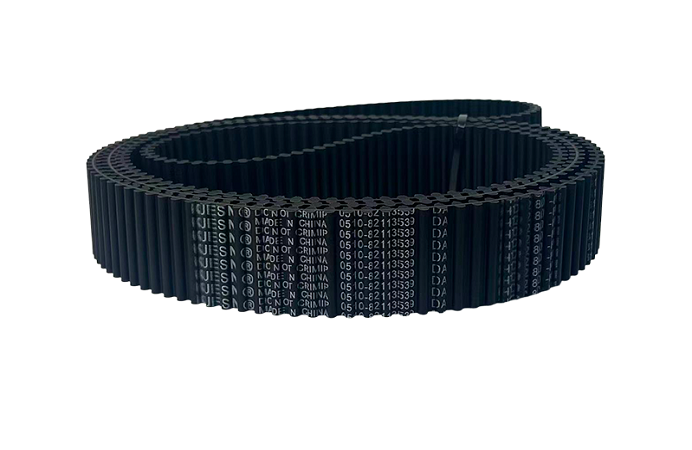
Vibration and unusual noise are often the earliest signals before visible wear sets in. Drives using low-noise polyurethane herringbone timing belts that reduce vibration-driven wear make this early warning stage easier to catch, since abnormal sound tends to stand out sooner against a quieter baseline. For safety procedures during inspection and lockout, OSHA's mechanical power-transmission apparatus standard outlines the guarding and inspection requirements that apply to belt-driven equipment.
Preventing Recurrence Through Better Component Selection
Fixing the immediate cause stops the current failure. Choosing better-matched components stops the next one. Drives that repeatedly show tooth wear despite correct tension and alignment often benefit from a belt and pulley pairing designed for tighter tolerance and more even load distribution in the first place.
high-stability curved tooth rubber timing belts for even load distribution spread meshing stress across a larger tooth surface than standard trapezoidal profiles, which reduces the concentrated wear that leads to premature tooth failure. On the pulley side, KUEISN's timing pulley range engineered for precise alignment is built to tighter tolerances that make misalignment-driven wear less likely to develop in the first place.
Recurring wear on the same drive, despite correct maintenance, is usually a sign that the original component specification wasn't matched to the actual load and environment — not that maintenance practices are failing.
When to Repair vs. When to Replace
Minor edge fraying without exposed cords, or light tooth rounding that hasn't progressed to chipping, can sometimes be addressed by correcting alignment or tension and monitoring the belt through its next service interval. Once tension cords are visible, teeth show chipping or missing sections, or cracking has spread across the belt back, replacement is the only safe option — a compromised belt under load risks sudden failure rather than gradual degradation.
The broader lesson holds across nearly every wear pattern covered here: the belt rarely fails in isolation. It's usually reporting a problem somewhere else in the drive — alignment, tension, temperature, or component match — and addressing that root cause is what actually extends equipment life, rather than just resetting the clock on the same failure.


Contact
-

+86-510-82113539
+86-18906170683
Got questions? Call us 24/7 -

[email protected]
Contact us now for a quote -

No.99 Fu Rong Zhong San Rd, Xishan District Economic and Technological Development Zones Wuxi City, Jiangsu, China
Copyright © Wuxi KUEISN Transmission Equipment Co.,Ltd.All Rights Reserved. OEM Industrial Timing Belt and Synchronous Pulley Manufacturer
