


 English
 Português
 Indonesia
Submit feedback
Rubber vs. Polyurethane Timing Belts: How to Choose the Right Material
A wrong belt material choice rarely fails loudly at first. More often, it shows up as recurring recalibration on a CNC router, a belt that cracks after six months in a washdown environment, or accelerating tooth wear that no one can explain. The decision between rubber and polyurethane comes down to four factors: operating temperature, positional accuracy requirements, chemical exposure, and budget. Here is what the data shows for each.
What Each Belt Is Made Of — And Why It Matters
Most rubber timing belts use neoprene (CR) or EPDM as the body compound, reinforced with fiberglass or aramid tension cords. The tooth surface carries a nylon fabric facing that reduces friction and cushions mesh contact. This layered construction gives rubber its defining trait: excellent flex fatigue resistance at high speeds and strong heat dissipation during continuous operation.
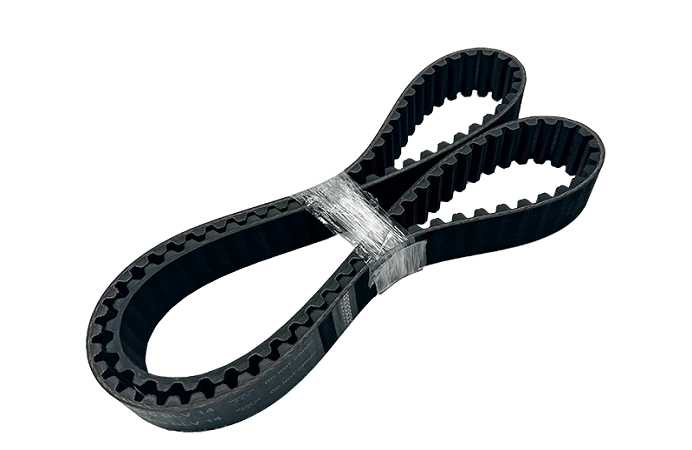
Polyurethane (PU) timing belts are cast or extruded as a single thermoplastic elastomer body, typically reinforced with steel or aramid cords. There is no fabric tooth facing — the PU compound itself is the wear surface. PU is significantly harder than rubber (Shore A 85–95 vs. Shore A 60–80), which translates directly into higher tooth shear strength and lower elongation under load. Open-ended PU belts can also be butt-welded or finger-joined on-site, a practical advantage no rubber belt can match.
Temperature: Where Rubber Holds a Clear Advantage
Rubber belts — particularly EPDM and HNBR compounds — operate reliably from −40°C to +120°C, with specialty grades rated higher. This is why rubber dominates automotive camshaft drives, HVAC systems, and any application where underhood or process heat is unavoidable.
Standard polyurethane belts are rated to +80°C continuous, with short-term peaks around 100°C. Above that threshold, PU softens, loses tooth shear strength, and wears rapidly. In cold environments, PU also stiffens significantly below −20°C, increasing crack risk under dynamic load. For high-temperature or thermally variable applications, trapezoidal rubber timing belts engineered for demanding thermal conditions are the more reliable long-term choice.
Precision and Dimensional Stability: Polyurethane's Strong Suit
For positional accuracy in CNC routers, 3D printers, pick-and-place robots, and linear actuators, polyurethane outperforms rubber by a meaningful margin. PU's lower elongation rate under load means less belt stretch and more repeatable positioning — in practical terms, a PU belt with steel cords in a 1-meter linear drive can hold positioning error under 0.05 mm, compared to 0.2–0.5 mm for a comparable rubber belt under cutting load.
PU also does not absorb moisture. Rubber can swell slightly with humidity, shifting tooth pitch and introducing timing drift in sensitive systems. If your application involves cleanrooms, medical devices, or precision instruments, polyurethane timing belts designed for high-accuracy and low-dust operation are the right starting point.
Chemical Resistance — Including Polyurethane's Hidden Weakness
PU resists aliphatic hydrocarbons, hydraulic fluids, oils, greases, ozone, and UV degradation well. Rubber — particularly neoprene — handles ketones, alcohols, and steam better, and holds up in outdoor weathering and ozone-heavy environments.
The critical limitation that many spec sheets understate: PU belts are vulnerable to hydrolysis. Prolonged exposure to water, steam, or high humidity above 60°C causes PU to break down at the molecular level, leading to sudden belt failure. This rules out standard PU belts for washdown food lines, steam-exposed pharmaceutical equipment, and outdoor installations in wet climates — unless a hydrolysis-resistant PU grade is specifically specified. In those scenarios, rubber is both safer and more economical.
Speed, Load, and Noise
Rubber handles high belt speeds better. Its lower stiffness and superior flex fatigue resistance allow rubber belts to run at up to 80 m/s in high-performance configurations. Automotive cam drives, high-speed spindles, and textile machinery all rely on this property. Standard PU belts are typically limited to around 50 m/s before heat generation from tooth impact and repeated flexing becomes damaging.
At low speeds and high torque, the dynamic reverses. PU's harder tooth surface and higher shear strength per unit area make it better suited to high-load, slow-turning drives — provided alignment and tension are properly set, since PU's stiffness concentrates mesh load on fewer teeth and accelerates localized wear in misaligned systems.
On noise, rubber wins consistently. The nylon fabric tooth facing absorbs impact and damps vibration at the mesh point. PU produces slightly higher operational noise, which is generally acceptable in industrial settings but relevant in office equipment, medical devices, or any noise-sensitive installation.
Installation Flexibility and Total Cost
Rubber belts come as pre-formed endless loops in standardized lengths, which means your drive geometry must fit available sizes or use a tensioner to compensate. PU open-ended belts can be cut and joined on-site to any required length, significantly reducing downtime during maintenance or custom conveyor installations. Note that field-welded PU belt joints typically reach 80–90% of parent material strength — for critical high-load drives, factory-molded endless PU belts are preferable where available.
On upfront cost, rubber is generally 20–50% less expensive than an equivalent PU belt. However, total cost of ownership can favor PU in precision-critical applications. A CNC machine that eliminates frequent recalibration due to belt stretch pays back the PU premium quickly. In an automotive engine running at 6,000 RPM and 110°C, rubber is both cheaper and longer-lasting — PU would be the wrong investment entirely.
How to Choose: A Practical Summary
Choose rubber when operating temperatures exceed 80°C, belt speed is above 30–40 m/s, the environment involves steam or repeated washdowns, quiet operation is required, or budget is a primary constraint. The full range of rubber timing belts for industrial and automotive applications covers these use cases across trapezoidal, arc-tooth, and double-sided configurations.
Choose polyurethane when positional accuracy is critical, the drive is low-speed and high-torque, custom belt lengths are needed, or the environment involves oils and solvents (but not steam or hot water). For help matching the right belt to your specific machine or industry, the application solutions by industry section covers robotics, food processing, textiles, agriculture, and more.
Neither material is universally superior. The right answer is always application-specific — and knowing exactly where each material's limits lie is what prevents premature failure in the field.


Contact
-

+86-510-82113539
+86-18906170683
Got questions? Call us 24/7 -

[email protected]
Contact us now for a quote -

No.99 Fu Rong Zhong San Rd, Xishan District Economic and Technological Development Zones Wuxi City, Jiangsu, China
Copyright © Wuxi KUEISN Transmission Equipment Co.,Ltd.All Rights Reserved. OEM Industrial Timing Belt and Synchronous Pulley Manufacturer
