


 English
 Português
 Indonesia
Submit feedback
How to Calculate Timing Belt Pitch and Length: Formula & Practical Guide
Every timing belt selection or replacement starts with two numbers: pitch and pitch length. Get them right and the drive runs quietly, lasts its rated service life, and needs no adjustment after installation. Get them wrong and you are chasing tension issues, premature tooth wear, or a belt that simply will not fit on the pulleys. This guide walks through the calculation sequence from scratch, with worked examples at each step.
The Two Measurements That Define Every Timing Belt
Pitch (P) is the center-to-center distance between two adjacent teeth, measured along the pitch line of the belt — not along the outer surface. It is the foundational parameter from which everything else is derived. Pitch determines which pulleys the belt can mesh with, and no substitution is possible: a T10 belt will not run correctly on an HTD 8M pulley even if the outside dimensions look similar.
Pitch length (L) is the total circumference of the belt, also measured at the pitch line rather than the outer surface. This is the number printed in belt part numbers and catalog listings, and it is the number you need to match when ordering a replacement or designing a new drive.
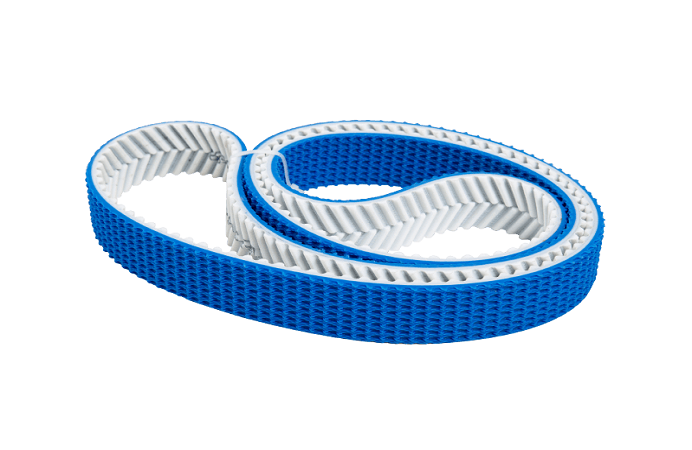
Step 1: Determine Belt Pitch
If you are working from an existing belt, the most reliable method is to use a digital caliper to measure the distance between the centerlines of two adjacent teeth while holding the belt flat and under light tension. Measure across at least three consecutive teeth and take the average to reduce error from tooth-to-tooth variation.
Common pitch values and their typical application ranges include T5 (5 mm) for light-load office and medical equipment, T10 (10 mm) for general industrial drives, HTD 5M and HTD 8M for higher-torque arc-tooth applications, and the imperial XL (5.08 mm) and L (9.525 mm) series still widely used in North American equipment. Trapezoidal rubber timing belts covering the full range of standard pitch sizes are a practical starting point when confirming which pitch your application requires.
If the belt has a visible part number, the pitch is usually embedded in it. A belt marked 600-5M-15 has a 5M (5 mm) pitch, a 600 mm pitch length, and a 15 mm width — no measurement needed.
Step 2: Calculate Pulley Pitch Diameter
The pitch diameter of a pulley is not the same as its outside diameter. It is the diameter at the pitch line — the theoretical circle traced by the belt's tension cord as it wraps around the pulley. For a timing pulley, the formula is straightforward:
d = (P × z) / π
Where P is the belt pitch in mm and z is the number of teeth (grooves) on the pulley. The engineering significance: pitch diameter sets the effective lever arm for torque transmission, so it directly controls your speed ratio and the load each tooth must carry.
As a worked example: a T10 pulley with 30 teeth has a pitch diameter of (10 × 30) / π = 95.49 mm. Its outside diameter will be slightly smaller — typically 1–2 mm less depending on tooth height — but the pitch diameter is the value to use in all subsequent length and center distance calculations. Timing pulleys matched to your belt pitch and tooth count carry manufacturer-specified pitch diameters that eliminate the need to measure each time.
Step 3: Calculate Belt Pitch Length for a New Drive
Once you have the pitch diameters of both pulleys and the intended center distance between shaft axes, the belt pitch length is calculated with the standard two-pulley drive formula:
L = 2C + π(d₁ + d₂) / 2 + (d₂ − d₁)² / (4C)
Where C is the center distance, d₁ is the pitch diameter of the smaller pulley, and d₂ is the pitch diameter of the larger pulley. The three terms represent the two straight spans of belt, the arc of contact on both pulleys combined, and a geometric correction for pulleys of unequal size. For drives where both pulleys are identical — common in linear motion and conveyor systems — the last term drops to zero and the formula simplifies to L = 2C + πd.
Worked example: two pulleys with pitch diameters of 63.66 mm (d₁, 20-tooth T10) and 95.49 mm (d₂, 30-tooth T10), center distance 200 mm.
- Straight spans: 2 × 200 = 400 mm
- Arc wrap: π × (63.66 + 95.49) / 2 = 249.9 mm
- Size correction: (95.49 − 63.66)² / (4 × 200) = 1.27 mm
- Total pitch length: 651.2 mm
This formula is consistent with established industry practice for synchronous belt center distance and pitch length calculation.
Step 4: Match to a Standard Belt Length and Adjust Center Distance
A calculated pitch length of 651.2 mm will not exist in any catalog. Belt manufacturers produce endless belts in fixed length increments — typically 5 mm or 10 mm steps for metric pitches. The practical approach is to select the nearest available standard length, then recalculate the center distance to match.
Rearranging the length formula to solve for C given a known L yields an approximate center distance: C ≈ (b + √(b² − 8(d₂ − d₁)²)) / 8, where b = 2L − π(d₁ + d₂). Most drives include a tensioner or slotted mounting to accommodate the ±5–15 mm of adjustment this typically requires. If your geometry is fixed and adjustment is impossible, polyurethane open-end belts that can be cut and welded to any exact length remove the constraint entirely.
For the full rubber timing belt catalog with standard pitch length listings, the nearest available size to 651.2 mm in T10 pitch would be 650 mm (65 teeth) — a 1.2 mm difference that translates to roughly 0.6 mm of center distance reduction, well within normal tensioner range.
Replacing an Existing Belt: Two Practical Methods
When you are replacing a worn belt rather than designing from scratch, the calculation simplifies considerably. The most accurate method is the tooth count method: count the total number of teeth on the old belt, then multiply by the pitch. A 65-tooth T10 belt has a pitch length of 65 × 10 = 650 mm. This method is definitive as long as the pitch is correctly identified first.
If the belt is too damaged to count teeth reliably, the string method gives a serviceable approximation: wrap a non-stretch cord around both pulleys along the exact belt path, mark the overlap, and measure. Add π multiplied by the belt thickness to convert from outer circumference to pitch length. Expect ±2–3 mm accuracy with this approach — sufficient for most standard belt replacements, but not for precision linear drives where exact pitch length matters.
Three Calculation Mistakes That Cause Drive Failures
Using outside diameter instead of pitch diameter. Pulley outside diameter is consistently smaller than pitch diameter — substituting it into the length formula will produce a belt that runs too tight, overloads bearings, and fails prematurely. Always use the manufacturer's specified pitch diameter or calculate it from tooth count and pitch.
Ignoring the last term in the length formula for unequal pulleys. The correction factor (d₂ − d₁)² / (4C) is small but not negligible when the speed ratio is large. For a 3:1 ratio drive with a 200 mm center distance, omitting this term introduces a 3–5 mm error — enough to require a non-standard belt length or cause persistent tensioning problems.
Installing without adjusting center distance. Selecting the nearest standard belt and installing it at the originally calculated center distance leaves the drive either over- or under-tensioned from day one. Always recalculate the required center distance for the actual belt selected, set it precisely, and check deflection force at the mid-span before running.
For applications with non-standard geometry, unusual speed ratios, or specialized material requirements, KUEISN's OEM and custom belt manufacturing service can produce belts to exact pitch length specifications rather than requiring the drive to adapt to catalog sizes.


Contact
-

+86-510-82113539
+86-18906170683
Got questions? Call us 24/7 -

[email protected]
Contact us now for a quote -

No.99 Fu Rong Zhong San Rd, Xishan District Economic and Technological Development Zones Wuxi City, Jiangsu, China
Copyright © Wuxi KUEISN Transmission Equipment Co.,Ltd.All Rights Reserved. OEM Industrial Timing Belt and Synchronous Pulley Manufacturer
