


 English
 Português
 Indonesia
Submit feedback
Timing Belt Applications in Agricultural Harvesters and Seeders | Power Transmission Guide
Every harvest season, the difference between a machine that keeps running and one that fails mid-field often comes down to a single component: the power transmission belt. Modern combine harvesters operate dozens of simultaneous mechanical actions—threshing, conveying, chopping, separating—and precision seeders must meter seeds at exact intervals across hundreds of acres. Both depend on reliable, synchronized power transfer. Timing belts, also known as synchronous belts, have emerged as the component of choice wherever accuracy and uptime matter most.
The scale of global crop production demanded by the world today means machinery downtime is never just a mechanical problem—it is a lost-yield problem. Understanding how timing belts function in harvesters and seeders, and how to select and maintain them correctly, is essential knowledge for equipment engineers, agricultural OEMs, and procurement teams alike.
Why Timing Belts Instead of V-Belts or Chains
Most power transmission engineers are familiar with V-belts. They are cost-effective, tolerant of misalignment, and capable of absorbing shock loads through controlled slip—useful, for instance, in a mower deck where the belt must give way rather than snap a shaft when the blade strikes a stone. But that same slip, which protects the drive in one scenario, is exactly what makes V-belts unsuitable for processes that demand precision.
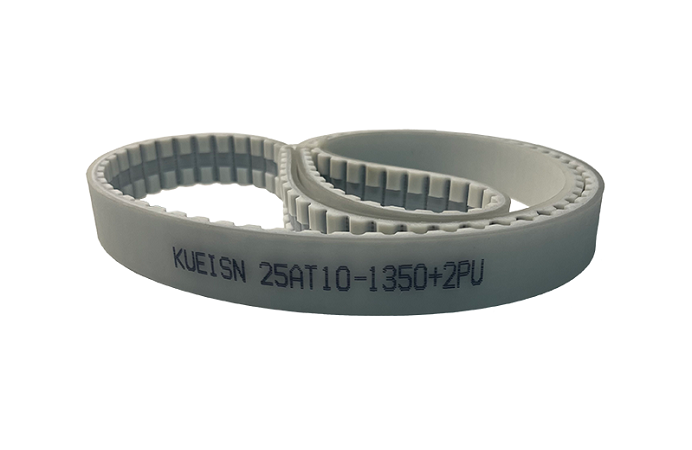
A timing belt operates on a fundamentally different principle. Its molded teeth engage directly with matching grooves in a toothed pulley (also called a sprocket or synchronous pulley), locking the belt mechanically to the drive. There is no reliance on friction, no tension-dependent slip, and no power loss through wedging action. This positive engagement delivers a fixed speed ratio across the entire operational range, keeps all driven components synchronized to one another, and eliminates the need for periodic retensioning once correctly installed.
In seeding equipment specifically, any deviation in the rotational speed of a seed metering disc translates directly into uneven seed spacing in the row. Even a 1–2% slip at higher forward speeds can cause clustering that reduces germination uniformity and measurable yield loss. A timing belt holds ratio within fractions of a percent, session after session, field after field. In combine harvesters, the threshing cylinder, concave, and separation rotors must maintain their relative speeds within tight tolerances to prevent grain damage or losses. Synchronous drive ensures that these relationships remain constant regardless of load fluctuations in the crop stream.
Timing Belt Applications in Combine Harvesters
The modern combine harvester is arguably the most mechanically complex vehicle in agricultural use. At any given moment, its systems are simultaneously cutting, conveying, threshing, separating, cleaning, and re-conveying grain—each process driven off a single engine through a hierarchy of belts, shafts, and gearboxes.
Timing belts appear at the points in this hierarchy where synchronization is non-negotiable. On disc cutterbar headers, the individual disc cutters must rotate in precisely coordinated sequences—a design requirement that was once met with expensive oil-bath gear trains. Replacing those gear trains with timing belt configurations reduces manufacturing complexity, eliminates the sealed transmission casing, and cuts maintenance requirements significantly while maintaining the phase accuracy needed to prevent the blades from contacting each other.
Threshing and separation rotors are another primary application. The relative speed ratio between the threshing cylinder and the concave determines the severity of threshing action; change it unintentionally and grain damage rates rise or separation losses increase. Timing belts on these drives hold the designed ratio regardless of whether the machine is processing light barley or dense maize, ensuring that operator-set parameters translate into consistent field performance.
On harvesters equipped with weed seed management mills—an increasingly common feature on high-specification machines—belt drives within the straw hood must transfer power from the main drive into compact spaces while being protected from the harsh environment of chopped straw and chaff. The positive engagement of timing belts in these enclosed drive paths allows design engineers to minimize the number of belts required while ensuring consistent mill rotor speeds.
Conveyors and elevators within the grain handling path represent a third application zone. Here, timing belts are often selected for their ability to maintain consistent belt velocity without the speed variations that occur when friction-based belts slip under varying grain loads. Consistent elevator speed reduces grain damage and ensures accurate flow-rate estimation by on-board yield mapping systems.
Timing Belt Applications in Seeders
Precision seeding has undergone a fundamental shift over the past two decades, moving from ground-wheel-driven bulk metering to individually driven seed discs with electronic rate control. Timing belts are central to both generations of this technology.
In mechanical drive systems, the ground wheel—or a PTO-derived drive—powers the seed metering units through a chain of transmission components. Wherever the drive path requires a fixed, accurate ratio between forward speed and seed disc rotation, timing belts replace chain or V-belt segments. The absence of slip means the theoretical seed spacing calculated by the gearbox ratio is what actually reaches the soil, rather than an average that fluctuates with belt wear and load variation.
Depth control systems on row crop planters are a particularly precise application. The furrow opener must maintain a consistent relationship between soil engagement force and disc angle as speed varies across uneven terrain. Timing belts in these actuation drives hold position accurately without the backlash inherent in chain drives, allowing depth to be maintained within a few millimeters even at high planting speeds.
For potato planters and vegetable transplanting equipment, belt-based conveyors handle individual tubers or plants, and the timing of delivery to the furrow must align exactly with the planter's forward speed to achieve target spacing. Synchronized belt drives govern this relationship, and any deviation from ratio causes doubles (two seeds or plants in one position) or skips (missed positions)—both costly outcomes in high-value horticultural crops.
The row drive on multi-row seeders is another critical point. Each individual row unit must meter seed at exactly the same rate for uniform population across the width of the machine. Where electric drives on each row are not used, a timing belt drive from a central shaft to each row metering unit distributes power with consistent ratio to every position, eliminating the population variation that affects yield maps and variable-rate application programs.
Rubber vs. Polyurethane: Choosing the Right Belt Material
Agricultural timing belts are produced in two primary material families, each with distinct performance profiles suited to different positions within a machine.
Rubber timing belts, typically constructed with a neoprene or EPDM body reinforced with fiberglass or steel cord tensile members, are the standard choice for the majority of agricultural drive positions. They handle shock loading well, offer good flexibility at low temperatures (operating reliably down to around -20°C), and their inherent elasticity provides some damping of vibration from threshing impacts. Rubber belts are broadly compatible with the oily, dusty, UV-exposed environment of field equipment, and their lower unit cost makes them appropriate for high-wear positions where periodic replacement is expected as part of routine maintenance. The range of rubber timing belt designs available for agricultural applications covers standard trapezoidal tooth profiles through to high-torque HTD and curved-tooth configurations suited to higher-load drive paths.
Polyurethane timing belts, reinforced with steel or Kevlar cords, offer measurably higher abrasion resistance, better chemical resistance, and superior dimensional stability over time. Where rubber belts may elongate gradually under sustained tension—particularly in warm, high-humidity conditions—polyurethane maintains its pitch length more consistently, preserving the positional accuracy of precision drives. Their temperature operating range extends to approximately 110°C at the upper limit, making them suitable for enclosed drives near engine heat sources. The trade-off is reduced flexibility at low temperatures and a higher unit cost; polyurethane belts are best applied where long service life and precision are the priority rather than shock load absorption. For high-precision synchronous drives requiring extended service intervals, polyurethane belt variants with special processing or wide-format configurations provide engineering flexibility for demanding agricultural applications.
In practice, most combine harvester and seeder drive systems use rubber timing belts for the majority of positions, with polyurethane specified selectively for critical drives where dimensional stability or chemical exposure justifies the premium. Material selection should be driven by the specific operating conditions of each drive station rather than a single policy applied across the machine.
The Role of Timing Pulleys in System Performance
A timing belt performs only as well as the pulleys it runs on. Pulley tooth profile, material, surface finish, and alignment all directly affect belt life and drive accuracy. In agricultural machinery, where dust, grit, and crop debris are constantly present, pulley design decisions have amplified consequences.
Timing pulleys for agricultural use are typically manufactured from cast iron, steel, or aluminum alloy, with the choice determined by load requirements, weight constraints, and operating environment. Cast iron pulleys offer excellent wear resistance in abrasive conditions; aluminum alloy reduces rotating mass, which matters on high-speed drives where inertia affects dynamic response. No-slip timing pulley designs with precision tooth geometry ensure that the belt's synchronous properties are fully realized in the field, without the small angular errors that can accumulate on worn or poorly manufactured pulleys.
Pulley alignment is the single largest preventable cause of premature belt failure in agricultural equipment. A misalignment of even a few tenths of a millimeter across a wide belt causes uneven tooth loading, accelerated edge wear, and lateral tracking forces that can cause the belt to ride off the pulley in rough terrain conditions. Design engineers specifying timing belt drives for harvesters and seeders should build in adjustment features at installation and specify inspection procedures that check alignment after each transport season.
For drives exposed to crop debris, pulley flanges that retain belt tracking without the need for additional guides reduce maintenance complexity. On open, dust-exposed drives, heat and wear-resistant pulley surface treatments extend service life in conditions where standard pulleys would require more frequent replacement.
Installation, Tensioning, and Maintenance in the Field
One of the practical advantages of timing belts over V-belts is the simplicity of their maintenance protocol. Unlike V-belts, which require periodic retensioning as the belt seats into the sheave groove and the tensile cords bed in, a correctly installed timing belt requires only one tensioning operation at installation. After that, the belt should maintain its designed tension throughout its service life without further adjustment—provided the drive is correctly designed and the belt is not exposed to contamination that damages the cord structure.
Correct initial tension is, however, critical. Undertensioning allows the belt teeth to skip under sudden load—a failure mode called "ratcheting" that rapidly destroys both belt and pulley. Overtensioning places excessive load on shaft bearings and accelerates fatigue cracking of the belt body. Tension specification is provided by belt manufacturers as a function of belt width, span length, and drive power, and should be verified with a suitable tensioning instrument rather than estimated by feel.
In harvester applications where drives are frequently removed for seasonal maintenance or component access, the correct re-installation procedure is as important as the initial installation. The belt should never be forced over a pulley using a lever; the center distance should be reduced to allow the belt to seat without excess force before the drive is tensioned to specification. Forcing a belt over a pulley risks invisible tensile cord damage that leads to premature failure in-season.
Contamination management is the primary environmental challenge for agricultural timing belt drives. Crop oils and juices accelerate rubber degradation; certain grain types carry silicate dust that is highly abrasive to both belt teeth and pulley grooves. Where contamination is unavoidable, enclosed drive covers that exclude debris extend service life significantly and are worth the additional design and manufacturing cost. Conveyor belt systems operating alongside timing belt drives in grain handling paths should also be specified with material compatibility in mind to prevent cross-contamination between different belt compounds.
Selecting Timing Belts for Agricultural OEM and Aftermarket Requirements
Agricultural equipment manufacturers face a different belt selection challenge than industrial machine builders. The same machine must operate reliably across a wide geographic range—from the high-humidity tropics to the arid steppes—with maintenance carried out by operators whose mechanical access and tooling may be limited. Belt specifications must therefore balance peak performance requirements against serviceability, availability, and cost of ownership over a machine's full working life.
For OEM specification, key selection parameters include belt tooth profile (matched to the pulley design), pitch (the distance between tooth centers, which determines the speed ratio precision and the range of pulley sizes available), width (determined by the power to be transmitted and the required safety factor), and material. High-stability curved-tooth rubber timing belt configurations deliver improved load distribution compared to classic trapezoidal profiles, reducing peak tooth stress in high-torque agricultural drives and extending belt life under the demanding duty cycles of harvesting equipment.
For aftermarket and replacement applications, the priority is cross-reference accuracy and supply reliability. A belt that is technically superior but unavailable during harvest creates more damage than a standard belt that arrives within 24 hours. Distributors serving agricultural markets should carry a breadth of standard sizes with reliable inventory, and should be equipped to advise on equivalent replacements for OEM-specified parts. The full range of power transmission belt products available for agricultural and industrial applications covers both standard catalog items and application-specific configurations for machines where off-the-shelf options do not meet drive requirements.
The synchronous belt characteristics explored throughout this article—fixed ratio, no retensioning, positive engagement, long service life when correctly specified and installed—address directly the pressures that agricultural operators and equipment makers face: shorter operating windows, larger machines with more parallel drive paths, and an increasing reliance on precision output data from yield monitors, variable-rate controllers, and telematics systems that depend on consistent mechanical execution to deliver accurate results.


Contact
-

+86-510-82113539
+86-18906170683
Got questions? Call us 24/7 -

[email protected]
Contact us now for a quote -

No.99 Fu Rong Zhong San Rd, Xishan District Economic and Technological Development Zones Wuxi City, Jiangsu, China
Copyright © Wuxi KUEISN Transmission Equipment Co.,Ltd.All Rights Reserved. OEM Industrial Timing Belt and Synchronous Pulley Manufacturer
