


 English
 Português
 Indonesia
Submit feedback
3 Environmental Factors Engineers Forget When Selecting Transmission Belts
A packaging line running three shifts a day looked fine on paper. The belt was rated for the plant's peak summer temperature, the enclosure kept out visible dust, and humidity sat within the manufacturer's stated range. Yet the timing belt failed at the tooth root eleven months into an eighteen-month warranty period, and nobody could explain why — the conditions matched the spec sheet.
The answer wasn't a single environmental limit being exceeded. It was three variables that rarely show up on a standard selection checklist, because they don't announce themselves as clearly as "too hot" or "too dirty." Engineers size belts against peak values — maximum temperature, maximum humidity — and miss the factors that operate in the background of every cycle.
Temperature Cycling, Not Just Peak Heat
Most selection guides ask one question about heat: what's the highest temperature the belt will see? That number matters, but it misses a different failure path entirely. A belt that never exceeds its rated temperature can still fail early if it's repeatedly heated and cooled — because the damage comes from the swing, not the ceiling.
Rubber and polyurethane compounds expand and contract at different rates than the reinforcing cords running through them. Every heating-cooling cycle creates a small mismatch in that expansion, and that mismatch shows up as internal stress concentrated right at the tooth root — the exact point already carrying the highest mechanical load during operation. A belt cycling between 40°F and 140°F twice a day accumulates fatigue damage that a belt held at a steady 140°F never experiences, even though the steady-state belt technically runs hotter.
This is why cyclic fatigue testing, such as the extension cycling methods described in ASTM's rubber property testing standards, evaluates materials differently than a simple heat-resistance rating does. A compound can pass a peak-temperature spec and still crack under cyclic conditions within a fraction of its expected life.
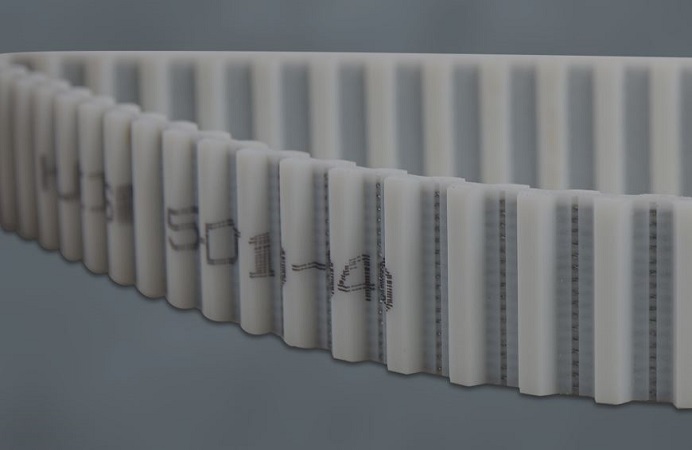
The practical fix is to check the daily and seasonal temperature range the belt actually sees — not just the worst single reading — and to look at how the tooth profile itself is engineered. Some heat- and wear-resistant timing pulleys designed for thermal cycling conditions pair a hardened contact surface with a compound formulated for repeated expansion and contraction, rather than optimizing for peak-temperature tolerance alone. On the belt side, polyurethane timing belts engineered for demanding thermal environments tend to hold dimensional stability better across swings than standard rubber compounds, largely because of how the polymer backbone is structured — a closer look at the material composition of polyurethane synchronous belts explains why that structure behaves differently under repeated thermal stress.
Particulate Size, Not Just "Dust Present or Absent"
Selection guides usually treat dust as a yes-or-no condition: either the environment is dusty and you need a sealed or shielded design, or it isn't and you don't. That binary skips the variable that actually determines whether particulate becomes a problem — how large the particles are relative to the tooth root radius.
Coarse particulate mostly settles on the belt's outer surface, where it's visible and gets cleaned or brushed away during routine maintenance. Fine particulate — metal fines from adjacent machining operations, flour or grain dust, fine mineral powder — behaves differently. It works its way into the tooth root, the small curved area where the tooth meets the belt backbone, and stays there. Every rotation grinds that particulate against the root under load, producing abrasive wear in a spot nobody inspects visually because it's hidden inside the mesh with the pulley.
By the time root wear is visible from the outside, the belt has usually already lost a meaningful percentage of its rated tensile strength. That's a different failure signature than surface glazing or edge fraying, and it's easy to misread as random or premature failure rather than a particulate issue, because the belt "looks fine" right up until it doesn't.
Two design responses matter more than a generic dust rating. First, tooth profile geometry: no-slip timing pulleys built to maintain grip in contaminated environments reduce the micro-slip that pumps particulate deeper into the root area with each cycle. Second, backbone and tooth compound hardness — harder, more abrasion-resistant compounds resist root wear even when some particulate ingress is unavoidable. Reviewing the full range of rubber timing belts by compound hardness rather than by price point is usually the faster way to solve this than adding another layer of enclosure.
Humidity Swings and Static Buildup
This is the factor most selection checklists get backwards. The instinct is to worry about high humidity — moisture, corrosion, swelling. But from a static-electricity standpoint, the more dangerous condition is often the opposite: low humidity, or a rapid drop from humid to dry.
Belts running against pulleys generate static charge through simple friction, the same mechanism as rubbing a balloon on a wool sweater. In humid air, that charge has a path to dissipate — moisture in the air is mildly conductive and bleeds the charge off continuously. When humidity drops, especially in a sharp seasonal transition or in a climate-controlled facility running dry air for other reasons, that dissipation path disappears and charge accumulates on the belt surface instead.
In most applications, that's a minor nuisance. In facilities handling combustible dust, sensitive electronics, or flammable vapors, it's a genuine ignition or component-damage risk — which is exactly why a formal body of electrostatic discharge standards exists specifically to define surface resistivity limits for conveying and drive components in these settings.
The practical takeaway: if a facility's humidity swings seasonally, or runs deliberately dry for process reasons, static risk should be evaluated at the driest point of the year — not the average. Where that risk is real, belt surface resistivity becomes a selection criterion in its own right, alongside tension rating and tooth profile. For conveying applications in particular, it's worth reviewing conveyor belt solutions for particulate-heavy environments with static dissipation properties built in, rather than treating it as an add-on accessory.
A Quick Self-Check Before Finalizing a Belt Order
Before locking in a belt specification, it's worth running through a short list that goes beyond the standard temperature/humidity/dust rating:
- Pull the facility's daily and seasonal temperature range, not just the single highest reading
- Check whether nearby processes generate fine particulate (machining, grinding, milling, powder handling) rather than just general ambient dust
- Identify the driest point in the annual humidity cycle, not the average humidity level
- Confirm whether the application involves combustible dust, flammable vapor, or static-sensitive components
- Match tooth and pulley geometry to the dominant wear mechanism identified above, not just to torque and speed requirements
None of these factors are exotic. They're simply easy to miss because they don't show up as a single number on a spec sheet — they show up as a pattern over time, which is exactly why they cause the failures nobody saw coming.


Contact
-

+86-510-82113539
Shirley: +86-18906170683
Got questions? Call us 24/7 -

[email protected]
Contact us now for a quote -

No.99 Fu Rong Zhong San Rd, Xishan District Economic and Technological Development Zones Wuxi City, Jiangsu, China
Copyright © Wuxi KUEISN Transmission Equipment Co.,Ltd.All Rights Reserved. OEM Industrial Timing Belt and Synchronous Pulley Manufacturer
