


 English
 Português
 Indonesia
Submit feedback
Toothed Drive Belts: Tooth Profiles, Materials & Pulley Matching
What Makes a Belt "Toothed": Positive Engagement Explained
Run a finger along the underside of a toothed drive belt and the difference from a flat or V-belt is immediate: rows of evenly spaced teeth built to lock into a matching pulley groove, one tooth at a time, without ever relying on friction alone.
This is called positive engagement. Instead of gripping a pulley through surface contact and tension, the belt's teeth physically mesh with grooves cut into the pulley face. There is no slip point to cross, so the driven shaft turns at an exact, predictable ratio to the driving shaft no matter how the load fluctuates.
That precision is why toothed belts show up wherever timing actually matters: engine camshafts, CNC axes, packaging lines, robotic arms. A secondary benefit is often overlooked in specification sheets — because the drive doesn't depend on tension to prevent slip, belts can run looser than a V-belt equivalent, which means less radial load on bearings and motor shafts over the life of the machine.
Tooth Profiles: Trapezoidal, Curvilinear, and Helical Herringbone
Not all teeth are cut the same way, and the shape has real consequences for how a drive performs under load. Trapezoidal profiles were the original design and remain common for general-purpose transmission — straightforward to manufacture, reliable for moderate torque, but prone to tooth deformation and higher noise as speeds climb.
Curvilinear (rounded) profiles distribute load across a larger tooth surface, which reduces localized stress and lets the belt handle higher torque at a smaller pitch. This is the profile of choice for compact drives that still need to move serious loads without upsizing the pulleys.
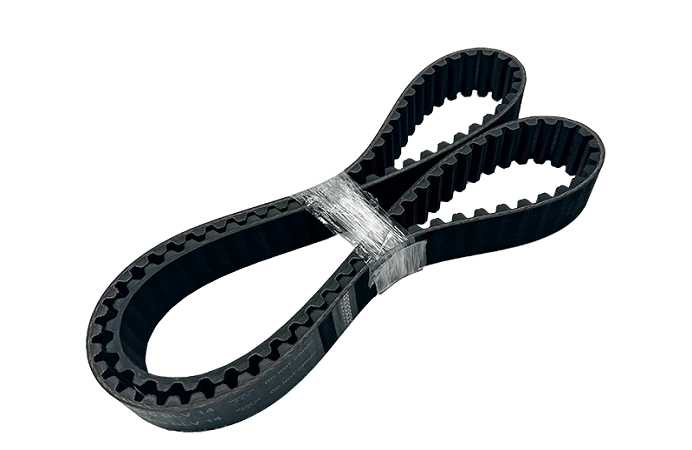
A third category worth knowing is the helical or herringbone tooth, where the teeth are cut at an angle and mirrored across the belt's centerline. The offset geometry helps the belt self-center on the pulley and resist lateral walking, which matters on longer center-distance drives. Kueisn's helical-tooth herringbone rubber timing belt with self-centering engagement is built around this principle for drives where tracking stability is a recurring headache. For applications where load capacity per pitch is the priority, the curved-tooth rubber timing belt built for stable high-load transmission covers the curvilinear side of the equation.
Rubber vs. Polyurethane: Choosing the Right Belt Material
Tooth profile decides how the belt engages; material decides how it survives its environment. Rubber toothed belts, typically compounded from chloroprene or similar elastomers with fiberglass or steel tension cords, remain the default for heavy general industrial duty — good abrasion resistance, wide temperature tolerance, and lower cost per meter for standard drive lengths.
Polyurethane belts trade some of that raw toughness for precision and cleanliness. They resist oils, most industrial chemicals, and moisture far better than rubber compounds, and they can be manufactured as open-ended stock that's cut, joined, or welded to custom lengths on demand. That flexibility makes polyurethane the more common choice in food processing, packaging, and electronics assembly, where contamination control and non-standard belt lengths are recurring constraints.
Kueisn stocks both material families as dedicated product lines: the full range of rubber toothed timing belts for general industrial drives, and the polyurethane toothed timing belt line for applications that need chemical resistance or custom lengths.
Matching Belt Pitch to Compatible Pulleys
Pitch — the center-to-center distance between adjacent teeth — is the number that decides whether a belt and pulley will work together at all. A belt cut to the wrong pitch may look like it fits, but it will ride high or low in the pulley groove, wear unevenly, and eventually skip teeth under load.
Beyond matching pitch, designers need to account for backlash: the small clearance between tooth and groove that allows smooth engagement but also introduces a tiny amount of positioning error. Drives that can't tolerate any backlash — indexing tables, precision robotics — often specify zero-backlash pulley sets machined to tighter tolerances than standard stock.
- Confirm pitch and profile match exactly between belt and pulley before ordering
- Flange at least one pulley on any drive where the belt could walk sideways
- Check minimum pulley diameter against the manufacturer's rating to avoid premature tooth cracking
For sourcing components as a matched system rather than reconciling separate specs, Kueisn's matched timing pulleys engineered for precise tooth engagement and the Eagle-series timing belt and pulley sets are built to pair without the guesswork of cross-referencing separate belt and pulley catalogs.
Industrial Applications: Conveying, Positioning, and Automation
Outside the engine bay, toothed belts do most of their work in two roles: moving product and moving tooling. Conveying applications favor wider belts that can carry a load across the belt face without twisting, while positioning applications — linear actuators, pick-and-place axes, gantry systems — depend on the belt's zero-slip characteristic to repeat the same position within fractions of a millimeter, run after run.
Both roles push belt width and length outside standard automotive dimensions, which is why wide-format polyurethane construction has become common in packaging and automation lines. Kueisn's wide polyurethane timing belt for conveying and positioning lines is sized for exactly this kind of duty, where standard-width automotive belts simply aren't built for the job.
Automotive Timing Belts vs. Industrial Drive Belts
An engine timing belt and an industrial toothed belt share the same engagement principle but are engineered for very different failure modes. Automotive belts are sized to tight factory tolerances, rated for continuous under-hood heat, and typically scheduled for replacement on a mileage or time interval regardless of visible wear — the cost of a missed interference-engine failure is simply too high to run belts to destruction.
Industrial belts, by contrast, are specified against load, speed, and duty cycle rather than a fixed replacement calendar, and they come in a far wider range of widths and pitches to match custom machinery rather than a handful of standardized engine platforms. Kueisn's highly adaptable automotive timing belt is built to the fit and heat-resistance requirements that vehicle applications demand, distinct from the broader sizing flexibility of the industrial lines above.
Maintenance Practices That Extend Belt Life
Toothed belts fail slowly, and almost always for one of three reasons: misalignment, incorrect tension, or contamination. Misalignment shows up first as uneven edge wear and a faint whine; left uncorrected, it accelerates tooth shear on one side of the belt long before the belt reaches its rated service life.
Tension is a more common mistake than it should be. Because toothed belts don't rely on tension for grip, over-tightening them doesn't improve performance — it just adds unnecessary load to bearings and shortens their life. Set tension to the manufacturer's specification, not by feel.
The payoff for getting this right is measurable. According to a U.S. Department of Energy technical report on industrial belt drives, synchronous belt drives maintain roughly 98 to 99 percent efficiency over their operating life, well ahead of V-belt systems that lose efficiency as they wear. That margin only holds up if the drive is installed and maintained correctly — a well-aligned, correctly tensioned toothed belt earns its efficiency rating; a neglected one gives most of it back.


Contact
-

+86-510-82113539
Shirley: +86-18906170683
Got questions? Call us 24/7 -

[email protected]
Contact us now for a quote -

No.99 Fu Rong Zhong San Rd, Xishan District Economic and Technological Development Zones Wuxi City, Jiangsu, China
Copyright © Wuxi KUEISN Transmission Equipment Co.,Ltd.All Rights Reserved. OEM Industrial Timing Belt and Synchronous Pulley Manufacturer
