


 English
 Português
 Indonesia
Submit feedback
Power Transmission Belts: Types, Selection Guide & Applications
What a Power Transmission Belt Actually Does
A single failed belt can stop a conveyor line, a compressor, or an entire production cell within seconds. That single point of failure is exactly why engineers spend so much time getting belt selection right in the first place.
A power transmission belt is a flexible loop that carries rotational force from a driving pulley to one or more driven pulleys, most often through friction, though some designs use a toothed, positive-engagement method instead. Compared with gears or chain drives, belts run quieter and need far less lubrication, and they absorb shock loads that would otherwise stress bearings and shafts. They also tolerate a certain amount of misalignment and varying shaft distances, which keeps installation and maintenance costs lower.
None of that means one belt fits every job. Load, speed, temperature, and precision requirements all push the decision toward a different type of belt — and Kueisn's full range of transmission belt and pulley products is built around exactly that range of use cases, from raw horsepower transfer to millimeter-accurate synchronization.
V-Belts: The Industrial Standard for Friction Drives
V-belts remain the default choice wherever a design calls for straightforward, cost-effective power transfer. Their trapezoidal cross-section wedges into a matching groove on the pulley, and that wedging action — rather than raw belt tension — is what keeps the belt gripping under load and resists slipping far better than a flat belt would.
Two families cover most industrial needs: classical-section belts (Y, Z, A, B, C, D, E) and narrower, space-saving sections (SPZ, SPA, SPB, SPC) that handle similar power in a smaller footprint. Reinforcement cord runs along the belt's neutral axis and typically uses polyester or nylon for general duty, moving up to aramid fiber when the application demands higher tensile strength without added bulk. For loads beyond what one belt can safely carry, multiple V-belts run side by side on a matched set of grooves — a configuration known as a multiple belt drive.
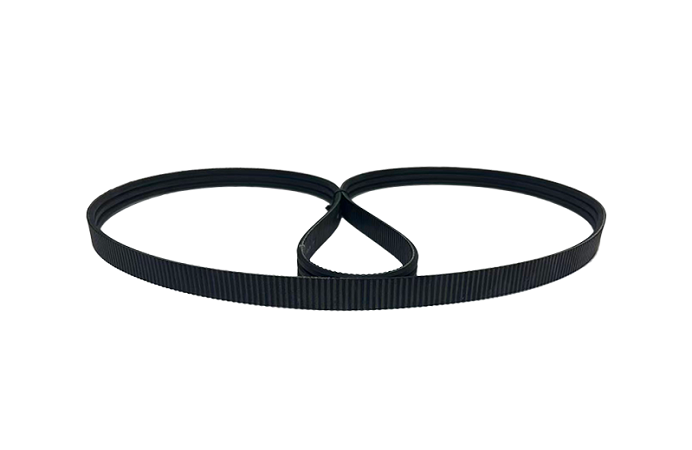
Kueisn's rubber and reinforced V-belt product line covers both classical and narrow sections, so matching an existing pulley groove to the correct belt profile is usually a matter of confirming the section letter and length code.
Rubber vs. Polyurethane Timing Belts: Choosing by Environment
Where V-belts rely on friction, timing belts use molded teeth that mesh directly with a grooved pulley — eliminating slip entirely and keeping the driven shaft locked to a precise rotational position relative to the driver. That's why timing belts show up wherever a camshaft, a stepper motor, or a linear positioning stage needs to stay perfectly in phase.
The material behind the teeth changes what the belt can handle. Rubber timing belts, typically built on a neoprene or chloroprene compound, cover the bulk of general industrial and automotive applications at a lower cost and with proven reliability across a wide temperature range. Polyurethane timing belts trade some of that flexibility for resistance: they hold up better against oil, ozone, and low-temperature environments, and their steel or aramid cords let them transmit more torque without stretching — which matters most in precision linear drives and food or chemical processing equipment where rubber degrades faster.
Kueisn manufactures both directions: rubber timing belt options built for standard industrial drives and polyurethane timing belts engineered for oil and chemical resistance, so the choice usually comes down to the operating environment rather than the load alone.
Herringbone and Eagle-Tooth Belts for High-Torque Drives
Standard timing belts run into a limitation at high torque: the teeth generate axial thrust that pushes the belt sideways off the pulley, which is why most designs need flanged pulleys to keep them tracking straight. Herringbone-tooth belts solve that differently — two rows of teeth angled in a mirrored V pattern cancel out the sideways thrust from each other, so the belt self-tracks without needing flanges at all.
That self-centering geometry, combined with a larger tooth engagement area, is what makes herringbone and eagle-tooth designs the standard choice for heavy printing presses, textile machinery, and other high-torque drives where a standard timing belt would walk off the pulley or wear out its flanges prematurely. The wider tooth base also spreads load more evenly, which extends service life under sustained heavy-duty operation.
Kueisn's Eagle-series herringbone timing belts and pulleys for high-load drives are built specifically for this category of application, where torque and running quietness both matter more than raw cost.
Pairing Belts with the Right Timing Pulleys
A timing belt is only as good as the pulley it runs on. Tooth profile, pitch, and width all have to match the belt exactly — a mismatch between profile systems, or even a slight pitch error, will cause teeth to jump under load or wear out in a fraction of the belt's rated life.
Pulley material matters too. Steel pulleys hold tighter tolerances and resist wear better under continuous heavy-duty operation, while aluminum pulleys cut weight in applications where inertia and acceleration response are the priority, such as servo-driven positioning stages. Flange placement also depends on the belt: standard trapezoidal-tooth belts generally need flanged pulleys to stay centered, while herringbone designs, as covered above, can often run flange-free.
Getting this pairing wrong is one of the most common causes of premature belt failure, which is why Kueisn offers precision timing pulleys matched to synchronous belt profiles alongside its belt lines rather than treating them as separate purchasing decisions.
Conveyor Belts: Moving Materials, Not Just Rotation
Not every belt in a facility is transmitting rotational power — some are moving the product itself. Conveyor belts serve a different mechanical purpose: instead of driving a second shaft, they carry material across a surface while being driven by one or more pulleys at either end.
That distinction changes the selection criteria. Load capacity and abrasion resistance matter more than tooth profile or torque rating. A lightly loaded assembly-line conveyor might run on a fabric-reinforced rubber belt, while bulk material handling on an incline calls for a textured or cleated surface to prevent product slip, plus a heavier ply rating to handle tension across a longer run. Environmental exposure — moisture, temperature, chemical contact — narrows the material choice further, much like it does with timing belts.
Kueisn's conveyor belt product range for material handling systems covers both light-duty and heavy-duty configurations, so the starting point is usually the load and incline angle rather than the motor's horsepower.
Automotive Belt Applications
Vehicles put both major belt types to work side by side, and each handles a job the other can't. A multi-ribbed serpentine belt runs the accessory drive — alternator, power steering pump, air conditioning compressor — off a single pulley system, which is why one belt failure can knock out several systems at once. A separate timing belt keeps the camshaft and crankshaft rotating in exact phase so that valves and pistons never collide inside the cylinder.
Both belts operate in a tighter, harsher environment than most industrial drives: high under-hood temperatures, oil and coolant exposure, and small-radius bends around closely spaced pulleys. That combination is why automotive-grade belts use different compound formulations and reinforcement than general industrial belts rated for a comparable load.
Kueisn's automotive belt products including fan and timing belts are built to that tighter automotive spec rather than adapted from industrial stock.
A Practical Framework for Belt Selection
Belt selection comes down to answering a short list of questions before opening a catalog: How much torque does the drive need to carry? What's the operating speed and center distance between shafts? Does the application require exact positional synchronization, or is friction-based power transfer enough? And what's the belt exposed to — heat, oil, moisture, or an explosive atmosphere that calls for antistatic construction?
The table below maps those answers to a starting point.
| Belt Type | Best For | Key Advantage |
|---|---|---|
| V-belts | General industrial drives, moderate cost targets | Simple, cost-effective, tolerant of minor misalignment |
| Rubber timing belts | Standard synchronization needs | No slip, wide temperature range |
| Polyurethane timing belts | Oil or chemical exposure, precision linear motion | High torque transfer with minimal stretch |
| Herringbone / eagle-tooth belts | High-torque drives needing flange-free tracking | Self-centering, quiet under heavy load |
| Conveyor belts | Material handling rather than shaft-to-shaft drive | Load-bearing surface with abrasion resistance |
Terminology across belt types is standardized internationally, which is worth knowing when comparing specification sheets from different manufacturers — V-belt and V-ribbed belt vocabulary defined under ISO 1081 is the reference most industrial catalogs draw from. Matching that vocabulary to the operating conditions above is what turns belt selection from guesswork into a straightforward spec match.


Contact
-

+86-510-82113539
Shirley: +86-18906170683
Got questions? Call us 24/7 -

[email protected]
Contact us now for a quote -

No.99 Fu Rong Zhong San Rd, Xishan District Economic and Technological Development Zones Wuxi City, Jiangsu, China
Copyright © Wuxi KUEISN Transmission Equipment Co.,Ltd.All Rights Reserved. OEM Industrial Timing Belt and Synchronous Pulley Manufacturer
