


 English
 Português
 Indonesia
Submit feedback
Eagle / Herringbone Timing Belts: Technology, Specs & Industrial Applications
What Are Eagle / Herringbone Timing Belts?
In industrial power transmission, the terms Eagle timing belts and herringbone timing belts are frequently used together — and for good reason. "Eagle" refers to the branded drive system pioneered by leading belt manufacturers, while "herringbone" describes the defining structural feature of those belts: a double helical offset tooth (H.O.T.) profile that forms a symmetrical arrow or chevron pattern across the belt width.
Unlike conventional straight-tooth synchronous belts, where each tooth engages the pulley groove all at once, a herringbone tooth meshes progressively and continuously along its angled flanks. This staggered engagement fundamentally changes how load is transferred — and unlocks a set of performance advantages that straight-tooth designs simply cannot match.
Eagle / herringbone timing belts are available in both open-end (cut-to-length) and closed-loop configurations, making them adaptable to a wide range of drive and conveying system architectures.
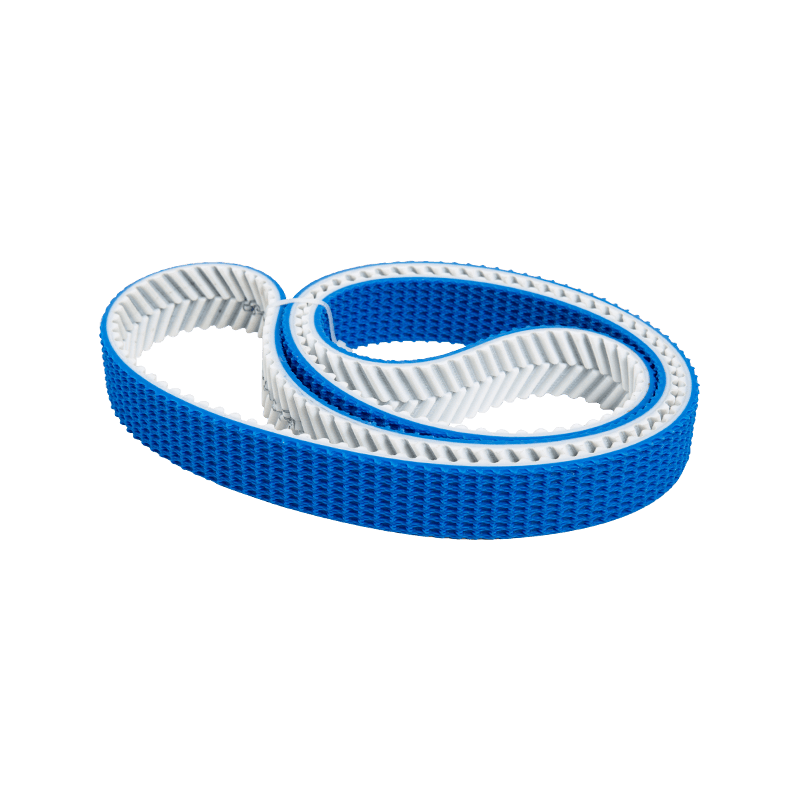
Key Technical Advantages of the Herringbone Tooth Profile
The herringbone tooth geometry delivers four performance benefits that directly translate to lower operating costs and longer service intervals:
- Near-silent operation: Because each tooth enters and exits the pulley groove gradually rather than all at once, impact noise is dramatically reduced. Eagle herringbone drives consistently outperform standard AT or HTD profiles in noise-sensitive environments such as food processing lines and packaging halls.
- Reduced vibration: Progressive meshing eliminates the periodic shock loading responsible for resonance and mechanical fatigue in conventional belt drives, extending bearing and shaft life.
- Self-tracking / flangeless design: The opposing helical angles on each half of the tooth naturally center the belt on the pulley. This eliminates the need for flanged pulleys in most horizontal and lightly inclined drives, reducing both component count and maintenance complexity.
- Bidirectional capability: Because the herringbone profile is symmetrical, these belts handle reversing applications without belt-edge wear or tracking correction — a limitation that affects many alternative self-guiding designs.
Taken together, these properties make Eagle / herringbone timing belts the preferred choice wherever engineers need to balance precision synchronization, quiet running, and minimal maintenance overhead.
Material Construction: What's Inside a Herringbone Timing Belt
The performance characteristics described above depend not just on tooth geometry, but on a carefully selected material stack. A standard Eagle / herringbone timing belt is built from three primary layers:
- Body material — Polyurethane (PU) or rubber: PU bodies offer superior hydrolysis resistance, dimensional stability, and a longer service life in humid or chemically aggressive environments. Rubber bodies (EPDM or CR compound) remain the standard choice for high-temperature automotive and heavy industrial drives.
- Tension member — Steel or aramid cord: High-tensile steel cord is the default, delivering the stiffness and load capacity required for most industrial drives. Aramid (Kevlar) cord is specified where reduced weight and resistance to elongation under shock load are priorities, such as in robotic arms or high-speed indexing tables.
- Tooth facing — Polyamide (nylon) fabric: A bonded nylon fabric layer protects tooth flanks from abrasion during repeated pulley engagement, directly contributing to the long meshing life that Eagle-type belts are known for.
For specialty applications, custom material combinations are available — including food-grade PU compounds, anti-static formulations, and high-temperature rubber compounds rated beyond 100 °C. Explore the full range of polyurethane and rubber herringbone belt configurations for precision conveying to identify the right construction for your application.
Industry Applications
The combination of quiet running, precise synchronization, and minimal maintenance requirements makes Eagle / herringbone timing belts suitable across a broad range of demanding environments:
- Textile machinery: Circular knitting machines, weaving looms, and yarn winders benefit from the low-vibration, high-repetition cycling that herringbone drives sustain without belt stretch or noise escalation.
- Food and beverage processing: PU herringbone belts with food-grade compounds comply with hygiene requirements while withstanding frequent washdown cycles. Common installations include baking mixers, slicing equipment, and portioning conveyors.
- Packaging and labeling lines: High-speed packaging conveyors rely on the self-centering property of herringbone belts to maintain consistent registration without constant manual tracking adjustment.
- Agricultural and wood processing equipment: Wood debarkers, hog dehairers, and grain conveyors expose belts to abrasive debris and shock loading — conditions where the reinforced PU body and aramid cord variant demonstrate a measurable service life advantage over standard rubber V-belts.
- Mining and aggregate handling: Aggregate crushers and mineral conveyor drives benefit from the flangeless design, which eliminates a common failure point in dusty environments where flanges trap abrasive particles.
- Printing and paper machinery: Paper presses and slitters demand sub-millimeter registration accuracy — achievable through the zero-backlash synchronous engagement that herringbone timing drives maintain across the full torque range.
Why Source Eagle / Herringbone Timing Belts from Kueisn
Wuxi Kueisn Transmission Equipment Co., Ltd. operates as both manufacturer and trading company, supporting OEM and aftermarket customers with Eagle-compatible herringbone timing belts across the full product spectrum.
Several capabilities distinguish Kueisn as a reliable supply partner:
- OEM replacement compatibility: Kueisn produces herringbone timing belts dimensionally compatible with leading Eagle-pattern drives from Continental, Goodyear, and equivalent brands — enabling direct drop-in replacement without system redesign.
- Dual-laboratory quality verification: Kueisn operates China's first synchronous belt physics and chemistry dual-performance laboratory. Every production batch undergoes both mechanical tensile testing and chemical compound analysis before shipment.
- Broad customization capability: Non-standard lengths, widths, pitches, cord materials, and surface coatings are accommodated. OEM logo printing on belt bodies is also available for reseller partners.
- Short lead times: Sample orders ship within 2–3 business days. Mass production orders are typically fulfilled within 10–15 days, with express options available for urgent requirements.
- Global export experience: Products serve customers across textile, photovoltaic, food processing, printing, petrochemical, and fitness equipment industries worldwide.
To discuss specifications, request a sample, or obtain a competitive quotation, submit a product inquiry for Eagle herringbone timing belts and pulleys and a technical sales engineer will respond within one business day.

Contact
-

+86-510-82113539
Shirley: +86-18906170683
Got questions? Call us 24/7 -

[email protected]
Contact us now for a quote -

No.99 Fu Rong Zhong San Rd, Xishan District Economic and Technological Development Zones Wuxi City, Jiangsu, China
Copyright © Wuxi KUEISN Transmission Equipment Co.,Ltd.All Rights Reserved. OEM Industrial Timing Belt and Synchronous Pulley Manufacturer
