


 English
 Português
 Indonesia
Submit feedback
Rubber Timing Belts: Materials, Tooth Profiles & Selection Guide
What Are Rubber Timing Belts?
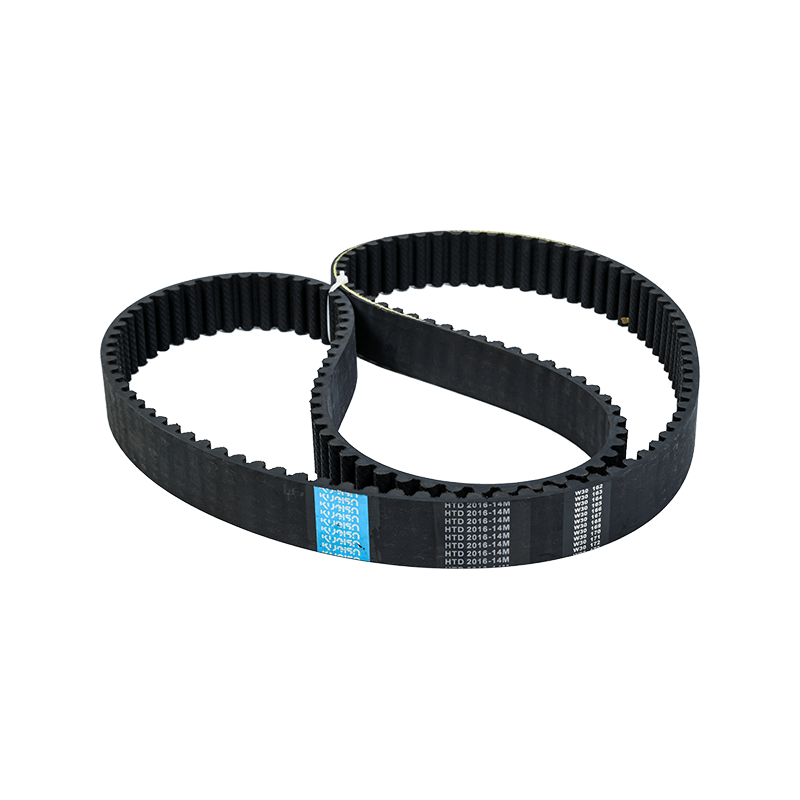
Rubber timing belts — also called synchronous belts — are toothed drive belts that transmit power between shafts through the positive engagement of belt teeth and pulley grooves. Unlike V-belts or flat belts, which rely on friction, rubber timing belts lock mechanically into the pulley, eliminating slippage entirely and maintaining precise shaft synchronization at all times.
A standard rubber timing belt is built from three core components: a rubber body (typically neoprene or EPDM) that forms the tooth profile and back, a tensile cord layer embedded lengthwise to resist elongation under load, and a nylon tooth facing bonded to the tooth surface to reduce wear and friction against the pulley. This layered construction is what makes rubber timing belts both flexible and dimensionally stable over long service cycles.
Because the drive is positive — meaning there is no creep or slip — rubber timing belts are widely used wherever precise motion control, consistent speed ratios, or shaft synchronization is required. They are a direct functional replacement for chain drives and gear systems in many applications, offering quieter operation and significantly lower maintenance demands.
Key Materials and Construction
The rubber compound used in the belt body determines how the belt performs across different temperature ranges, chemical environments, and load conditions. The two most common materials are chloroprene rubber (CR, also called neoprene) and EPDM (ethylene propylene diene monomer).
Chloroprene (neoprene) has been the industry standard for decades. It offers good oil resistance, moderate heat tolerance (typically up to around 100°C), and reliable mechanical strength across a broad range of general industrial applications. Most classic timing belt profiles — XL, L, H, HTD — are manufactured in neoprene.
EPDM is increasingly used in higher-performance applications. It delivers superior resistance to heat, ozone, and environmental aging compared to neoprene, making it the preferred choice for drives exposed to outdoor conditions or elevated operating temperatures. EPDM-based belts also tend to maintain their mechanical properties more consistently over longer service intervals.
The tensile cord is equally important. Fiberglass cords are standard in most light-to-medium duty belts: they are lightweight, resist elongation well, and are cost-effective for the majority of industrial drives. For heavy-duty or high-torque applications, steel tensile cords provide substantially higher breaking strength and lower elongation under peak loads. The combination of rubber compound and cord material should be selected together based on the specific demands of the drive system.
Common Tooth Profiles and Size Standards
Tooth profile determines how the belt engages with the pulley, and directly affects load capacity, backlash, noise level, and suitability for high-speed or high-torque operation. Selecting the wrong profile — even with correct pitch and width — can result in premature wear or insufficient power transmission.
| Profile | Tooth Shape | Pitch Range | Best For |
|---|---|---|---|
| MXL / XL / L / H / XH | Trapezoidal | 2.032 mm – 22.225 mm | General industrial drives, light-to-medium duty |
| T2.5 / T5 / T10 / T20 | Trapezoidal (metric) | 2.5 mm – 20 mm | Metric machinery, conveyor systems, packaging |
| HTD (3M / 5M / 8M / 14M) | Curvilinear (round) | 3 mm – 14 mm | Higher torque drives, reduced tooth shear stress |
| RPP / STD / S-series | Curvilinear (modified) | 3 mm – 14 mm | High-performance drives, improved load distribution |
| AT5 / AT10 / AT20 | Trapezoidal (modified) | 5 mm – 20 mm | Linear drives, high positioning accuracy |
Curvilinear profiles such as HTD and RPP distribute tooth load more evenly across the contact area compared to classic trapezoidal designs. This reduces stress concentration at the tooth root, enabling higher torque transmission without increasing belt width. For most new drive system designs, curvilinear profiles are the recommended starting point.
Advantages Over Chains and V-Belts
Rubber timing belts offer a distinct set of operational advantages that make them the preferred choice in many industrial drive applications where chains or V-belts were previously used.
- No lubrication required. Unlike roller chains, rubber timing belts operate completely dry. There is no oil bath, no periodic re-greasing, and no contamination risk in food, pharmaceutical, or cleanroom environments.
- High transmission efficiency. A properly tensioned rubber timing belt can transmit up to 98% of input power to the driven shaft, minimizing energy loss compared to chain drives or slip-prone V-belt systems.
- No re-tensioning needed. Because the tensile cord resists elongation by design, rubber timing belts maintain their tension over time. This eliminates the periodic adjustments that chain and V-belt drives require.
- Quiet operation. The tooth-and-pulley engagement of a rubber timing belt produces significantly less noise than a metal chain running at equivalent speeds, making it suitable for noise-sensitive environments.
- Long service life. Depending on operating conditions and correct sizing, rubber timing belts can achieve between 10,000 and 20,000 operating hours before replacement is needed.
Industry Applications
Rubber timing belts are used across a wide range of industries wherever precise, maintenance-free power transmission is required. Their versatility comes from the combination of available tooth profiles, materials, and belt widths that can be matched to almost any drive requirement.
- Textile machinery: Rubber timing belts drive spindles, yarn feeders, and warp beam systems where consistent speed ratios and zero slippage are critical to fabric quality.
- Photovoltaic equipment: Solar panel manufacturing lines use rubber timing belts in panel transport, cell sorting, and lamination conveyor systems that demand high precision and continuous-duty reliability.
- Packaging machinery: High-speed wrapping, filling, and sealing machines rely on rubber timing belts to synchronize multiple axes simultaneously, maintaining accurate phase relationships between stations.
- Printing and labeling: Web-fed printing presses use timing belts to maintain register accuracy between print heads, ensuring color alignment at production speeds.
- Food processing: The oil-free, easy-to-clean nature of rubber timing belts makes them well-suited for conveyors and portioning equipment in food production environments.
- Machine tools and CNC equipment: Axis drives in milling machines, lathes, and engraving equipment use rubber timing belts to transmit servo motor output to lead screws or table drives with minimal backlash.
Rubber vs. Polyurethane Timing Belts
When specifying a timing belt, one of the first decisions is whether to use a rubber or polyurethane (PU) body. Both materials form the basis of synchronous belt drives, but they perform differently depending on the application environment.
Rubber timing belts — particularly neoprene and EPDM types — are generally the better choice for high-torque, high-speed drives in industrial machinery. They handle larger belt widths more readily, are available in a wider range of tooth profiles, and perform well across the temperature ranges found in most factory environments. They are also typically more cost-effective for standard industrial use.
Polyurethane timing belts, by contrast, offer advantages in applications requiring higher dimensional stability, better resistance to hydrolysis, or open-end belt configurations for linear drives. PU belts are often preferred in precision linear positioning systems, conveyor applications with product contact, or environments with exposure to water and cleaning agents.
For drives requiring welded open-end belts, very fine pitch profiles, or specific chemical resistance, PU timing belts may be the more suitable option. Understanding the operating environment and load profile is essential before making a final material selection.
How to Select the Right Rubber Timing Belt
Correct belt selection begins with defining the mechanical requirements of the drive, then matching those requirements to the available belt specifications. Working through the following parameters systematically will lead to the most reliable outcome.
- Pitch and tooth profile: The pitch must match the pulley groove spacing exactly. Select a tooth profile based on the torque level — trapezoidal profiles for lighter loads and general use, curvilinear (HTD/RPP) profiles for higher torque or frequent reversals.
- Belt width: Wider belts carry higher loads. Width is typically calculated from the design power of the drive with an appropriate service factor applied for shock loading, starting conditions, or duty cycle.
- Belt length: Determined by center distance between pulleys and the pulley diameters. For endless (joined) belts, length must match the available pulley configuration. Open-end belt stock can be cut to the required length for linear drive applications.
- Operating temperature: Verify that the rubber compound is rated for the expected ambient and surface temperature at the belt. EPDM compounds generally offer better high-temperature performance than standard neoprene.
- Chemical exposure: If the belt will be exposed to oils, solvents, cleaning agents, or outdoor weathering, confirm compound compatibility before specifying. Some environments will require a specific rubber grade or a switch to PU construction.
- Custom requirements: For non-standard pitch, special widths, custom tooth geometry, or profiled belt backs for conveyor applications, custom manufacturing is available. Confirming lead times and minimum order quantities at the design stage avoids delays during production ramp-up.
Pairing the belt with correctly matched timing pulleys — in terms of tooth profile, pitch, and width — is equally important. A belt running on a mismatched pulley will wear prematurely regardless of how well the belt itself is specified.


Contact
-

+86-510-82113539
Shirley: +86-18906170683
Got questions? Call us 24/7 -

[email protected]
Contact us now for a quote -

No.99 Fu Rong Zhong San Rd, Xishan District Economic and Technological Development Zones Wuxi City, Jiangsu, China
Copyright © Wuxi KUEISN Transmission Equipment Co.,Ltd.All Rights Reserved. OEM Industrial Timing Belt and Synchronous Pulley Manufacturer
