


 English
 Português
 Indonesia
Submit feedback
The Secret of High-Speed Transmission in Textile and Printing: How Timing Belts Handle Extreme Conditions
A modern high-speed weaving loom cycles at over 1,000 insertions per minute. A commercial web offset press runs paper through at 15 meters per second. These are not gentle operating conditions — they are sustained mechanical extremes that expose every component in the drive train to heat, vibration, tension fluctuation, and contamination simultaneously. The timing belt running inside that equipment does not get a break between shifts. Understanding how it survives, and why it eventually does not, starts with understanding what these industries actually demand from a power transmission component.
What "High Speed" Actually Means for a Timing Belt
Speed in belt drive engineering is measured not in RPM but in belt velocity — the linear speed at which the belt surface travels across the pulley. At moderate industrial speeds, this figure sits comfortably below 20 meters per second. Textile and printing applications routinely exceed 30 m/s, and some specialized drives push past 40 m/s in continuous operation.
At those velocities, aerodynamic drag on the belt becomes a real load factor. The belt is effectively moving through air at high speed, and the turbulence generated at the tooth-pulley interface creates pressure fluctuations that contribute to noise and vibration. More critically, centrifugal force acts outward on the belt as it wraps around the pulley, reducing the effective tension holding the teeth in mesh. A belt that is correctly tensioned at rest may be operating at the edge of tooth-jump threshold at full running speed — a condition that is invisible during static inspection and only reveals itself as tooth wear or occasional skip events during high-load moments.
Pulley diameter selection becomes especially important at high belt velocities. Larger pulleys reduce the bending frequency the belt experiences per unit time, extending fatigue life. They also reduce the centrifugal tension loss for a given linear speed. In textile and printing drive design, minimum pulley diameter recommendations are set conservatively for exactly this reason — running a high-speed drive on undersized pulleys to save space is a reliable way to halve belt service life.
Thermal Management: Heat the Belt Cannot Escape
Every tooth-mesh event generates a small amount of heat through hysteresis — the internal friction within the belt material as the tooth deforms into the pulley groove and then recovers. At 10 mesh events per second this is negligible. At 500 or 1,000 events per second, accumulated hysteresis heating becomes a genuine thermal load that the belt must dissipate faster than it accumulates.
Textile machinery compounds this problem with its operating environment. Looms and spinning frames generate airborne fiber — cotton dust, synthetic filaments, short fiber fragments — that settles on belt surfaces and insulates them. A thin layer of fiber accumulation reduces heat dissipation significantly, raising belt operating temperature above the design range even when ambient conditions are normal. This is one of the primary reasons timing belts in textile environments fail earlier than calculated service life predictions suggest they should.
Printing presses add ink mist and paper dust to the contamination profile. Ink aerosols that deposit on belt surfaces change the friction characteristics at the tooth-pulley interface and, depending on the ink chemistry, may interact with the belt compound. Solvent-based inks present a particular risk for rubber belts, accelerating surface degradation in ways that are not always visible until the belt has already lost structural integrity.
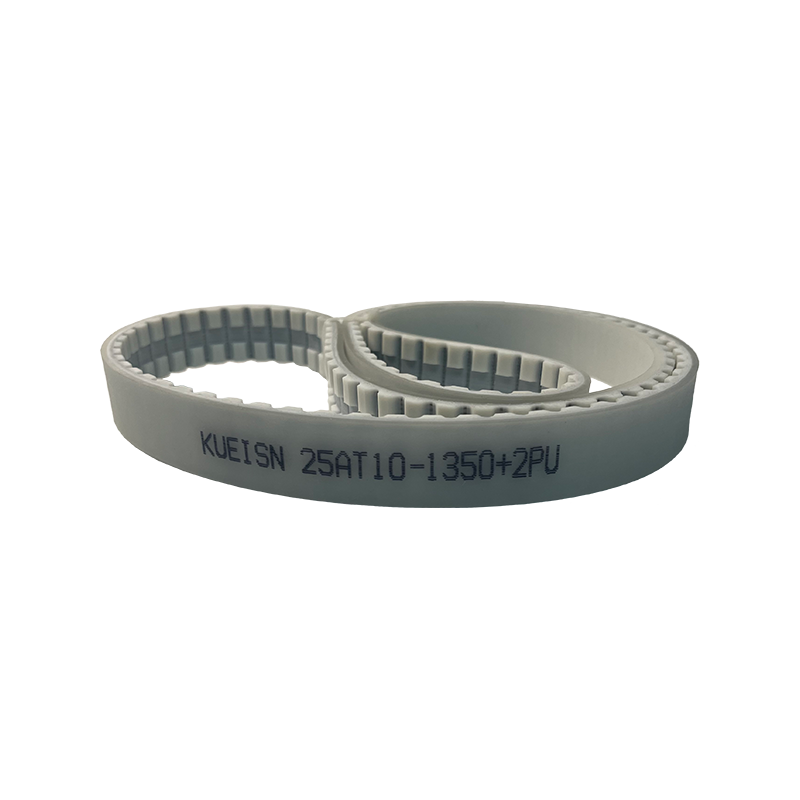
Polyurethane belts handle thermal and contamination stress more effectively than neoprene in most printing applications. The harder surface resists fiber and dust adhesion, dissipates heat more efficiently due to higher thermal conductivity, and is broadly resistant to the solvent and oil contamination that printing environments generate. The trade-off is reduced vibration damping — in drives with significant shock loading or speed fluctuation, the stiffer polyurethane transmits more dynamic load into the pulleys and bearings.
Synchronization Demands Across Multiple Shafts
A printing press is not a single-axis machine. Registration — the precise alignment of successive color layers on the printed substrate — depends on every driven roller, plate cylinder, and blanket cylinder maintaining exact phase relationships with every other. A timing error of a fraction of a degree in any one drive translates directly into visible misregistration on the printed sheet, which means wasted stock, press downtime for re-registration, and customer complaints.
This is the environment where belt elongation characteristics matter most. A belt that stretches differently under varying load — during acceleration from a cold start, during heavy ink coverage runs that load the impression cylinders, during deceleration for a web splice — introduces cyclic phase errors that are extremely difficult to diagnose and compensate for. Steel-cord timing belts are the standard choice for press main drives precisely because steel tensile cords maintain consistent pitch under varying loads, keeping the phase relationship between cylinders stable across the full operating range.
Textile weaving machines have an equally demanding synchronization requirement. The relationship between the main shaft, the dobby or jacquard mechanism, the let-off roll, and the take-up roll must be held constant through millions of cycles without drift. Any cumulative phase error produces a weaving defect — a visible line in the fabric that can render the entire roll unusable. Belt selection and tension maintenance in these drives are treated as quality-critical parameters, not routine maintenance items.
Tooth Profile Selection for High-Frequency Mesh
Classical trapezoidal tooth profiles — the XL, L, and H series that dominated industrial belt drives for decades — were not designed with high-speed, high-frequency mesh in mind. The angular tooth walls create stress concentrations at the root during each engagement cycle, and at high mesh frequencies these stress cycles accumulate rapidly. Fatigue cracking at the tooth root is the characteristic failure mode of trapezoidal belts in high-speed textile and printing drives.
Curvilinear profiles address this directly. The rounded tooth geometry distributes engagement stress across a broader area, reducing peak stress at the root and extending the number of load cycles the belt can sustain before fatigue failure. AT-pitch and HTD profiles have largely replaced classical trapezoidal belts in new textile and printing machinery designs for this reason. The improvement in fatigue life in high-frequency applications is not marginal — well-engineered curvilinear belt drives in printing applications routinely achieve two to three times the service life of comparable trapezoidal arrangements under identical load conditions.
Belt width also deserves attention in high-speed drives. Narrower belts have less mass per unit length, which reduces centrifugal tension loss at high velocities and improves dynamic behavior. Where load capacity allows, designers favor narrower belts on larger-diameter pulleys over wider belts on smaller pulleys — a combination that manages both centrifugal effects and bending fatigue simultaneously.
Tension Stability Over Long Running Periods
High-speed drives are particularly sensitive to tension drift. A belt that loses tension gradually — through cord relaxation, thermal expansion of the drive structure, or bearing wear that increases center distance slightly — may run acceptably for weeks before the cumulative slack manifests as tooth jump during a high-load moment. By the time the event occurs, the belt teeth have been accumulating wear at the root for a long time, and the remaining service life is short.
Automatic tensioning systems are common in high-end textile and printing machinery for exactly this reason. A spring-loaded or pneumatically controlled idler maintains consistent belt tension regardless of thermal expansion, cord settling, or minor structural deflection. These systems eliminate the variability introduced by manual tensioning and the degradation that occurs between scheduled maintenance intervals.
Where automatic tensioning is not fitted, the maintenance interval for tension verification should be shorter than general-purpose machinery guidelines suggest. The consequence of an undertensioned belt in a high-speed printing or textile drive is not a gradual performance decline — it is a sudden, high-energy failure that can damage pulleys, jam mechanisms, and halt production for hours. The cost of a scheduled tension check is trivial by comparison.
Designing for Longevity in Demanding Cycles
No timing belt lasts forever in a high-speed textile or printing environment, but the gap between a belt that runs 3,000 hours and one that runs 800 hours is almost always traceable to specific engineering decisions: tooth profile, tensile cord material, tension management, pulley sizing, and contamination control. None of these are exotic or expensive interventions. They are the cumulative result of matching component selection to actual operating conditions rather than to catalog minimums.
The machinery manufacturers who build the most reliable high-speed equipment do not treat timing belt selection as a procurement detail. They treat it as a design parameter — specified with the same rigor as bearing selection or shaft dimensioning. That discipline, applied consistently, is what separates equipment that runs reliably through three shifts from equipment that keeps the maintenance crew busy.


Contact
-

+86-510-82113539
Shirley: +86-18906170683
Got questions? Call us 24/7 -

[email protected]
Contact us now for a quote -

No.99 Fu Rong Zhong San Rd, Xishan District Economic and Technological Development Zones Wuxi City, Jiangsu, China
Copyright © Wuxi KUEISN Transmission Equipment Co.,Ltd.All Rights Reserved. OEM Industrial Timing Belt and Synchronous Pulley Manufacturer
