


 English
 Português
 Indonesia
Submit feedback
The "Joints" of Industrial Robots: The Key Role of Timing Belts in Automation
Pull back the cover on a collaborative robot arm or a high-speed SCARA unit and the mechanism inside looks deceptively simple — a compact arrangement of motors, housings, and belts. The belts, in particular, tend to be overlooked. They are small, quiet, and largely invisible during operation. Yet remove them from the equation and the robot becomes a rigid, immovable structure. Timing belts are not peripheral components in industrial robotics. They are the connective tissue that makes coordinated, precise motion possible.
Why Robots Use Timing Belts Instead of Direct Drive
The fundamental challenge in robot joint design is reconciling two competing requirements: high torque output and compact form factor. The motors capable of generating sufficient torque to move a robot arm under load are, by nature, larger and heavier than what the distal joints of a robot can accommodate. Placing a full-sized servo motor directly at each joint would make the arm too heavy to lift its own weight, let alone a useful payload.
Timing belts solve this by separating the motor from the joint it drives. Motors can be mounted proximally — closer to the robot's base, where their weight has less effect on the arm's dynamic performance — and their output transmitted through a belt-and-pulley arrangement to the joint. This configuration keeps the distal portions of the arm light and fast, while still delivering the torque and positioning accuracy the application demands.
Unlike chain drives or gear trains, timing belts achieve this power transmission with no backlash under proper tension, very low noise, and zero lubrication requirements. In a cleanroom semiconductor handler or a sterile pharmaceutical assembly cell, those last two properties are not conveniences — they are hard requirements that eliminate most alternative drive mechanisms from consideration entirely.
Joint-by-Joint: Where Timing Belts Appear in a Robot Arm
In a six-axis articulated robot, timing belts are most commonly found in the wrist joints — axes four, five, and six. These joints demand the smallest, lightest drive arrangements while still executing rapid, precise rotational movements. A timing belt connecting a motor mounted further up the arm to a wrist-joint pulley allows the wrist assembly to remain compact without sacrificing speed or repeatability.
SCARA robots — the four-axis units widely used in electronics assembly and small-parts handling — rely on timing belts for their two rotational arm joints. The flat, planar geometry of a SCARA arm makes belt routing particularly clean: the belts run parallel to the arm structure, keeping the overall profile low and minimizing interference with the workspace. The speed advantages of SCARA architecture depend directly on keeping the arm lightweight, and timing belts contribute significantly to that goal.
Delta robots, the three-armed parallel kinematic units used in high-speed pick-and-place applications, use timing belts to connect the central servo motors to the upper arm links. The characteristic performance of a delta robot — cycle rates exceeding 150 picks per minute in some configurations — is only achievable because the driven components are extremely light. Every gram saved in the arm structure translates directly into faster acceleration and deceleration without increasing motor size or energy consumption.
Positional Accuracy and the Role of Belt Stiffness
Repeatability is the metric that industrial robot buyers watch most closely — the ability of the robot to return to the same point in space, cycle after cycle, to within a specified tolerance. High-end articulated robots achieve repeatability figures of ±0.02 mm or better. Achieving that level of consistency requires every element in the drive chain, including the timing belt, to contribute minimal and predictable compliance.
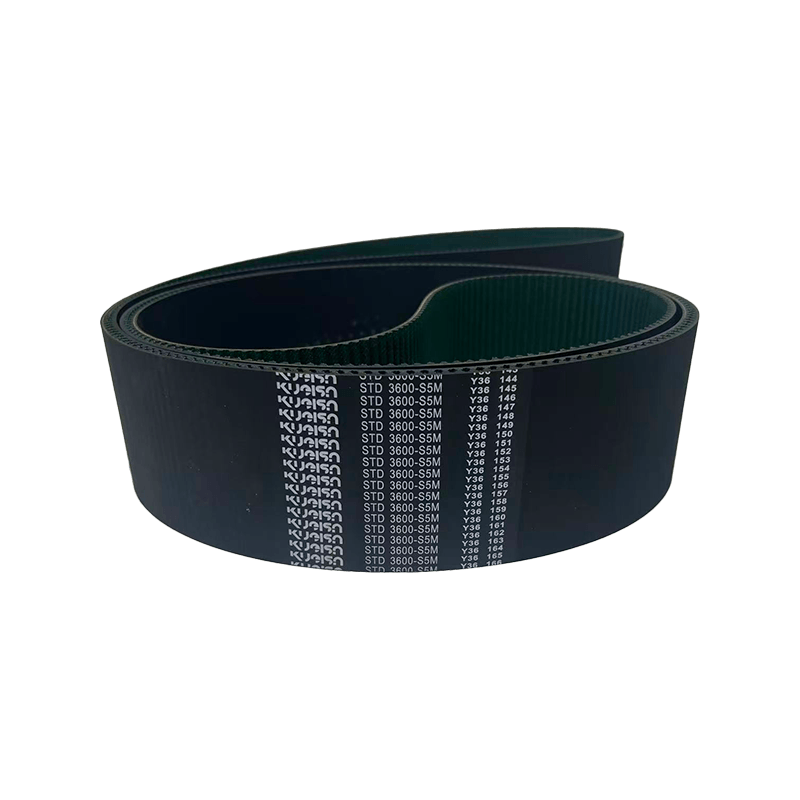
Steel-cord timing belts are the standard for precision robot joints because steel has essentially zero creep under sustained load and extremely low elongation under dynamic loading. When the servo motor commands a precise angular displacement, the belt transmits that command to the joint pulley with negligible elastic deformation. The result is a drive chain where the encoder feedback at the motor reflects — with very high fidelity — the actual position of the joint.
Belt tension management is critical to maintaining this accuracy. An undertensioned belt introduces a small amount of backlash-like play at the tooth-mesh interface; an overtensioned belt loads the motor bearings and joint bearings excessively, accelerating wear and increasing power consumption. Robot manufacturers specify tight tension windows for each joint belt, and service procedures typically include tension verification as part of every scheduled maintenance interval.
Speed, Acceleration, and Inertia Matching
Robot performance is not just about where the tool center point ends up — it is about how quickly and smoothly it gets there. The timing belt's pulley ratio is one of the primary tools robot designers use to match motor inertia to joint load inertia, a parameter that profoundly affects the dynamic response of the system.
A motor spinning fast through a reduction ratio reaches its destination faster than one turning slowly at a 1:1 ratio, even if both deliver the same torque at the joint. Timing belt drives allow robot designers to select this reduction ratio independently of the motor-to-joint distance, providing a degree of layout flexibility that geared arrangements do not. The belt ratio can be adjusted simply by changing pulley diameters — a minor mechanical change compared to redesigning a gearbox.
In high-speed applications, the belt's own mass and rotational inertia become design parameters. Narrower belts with tighter pitch reduce the belt's contribution to system inertia, improving the acceleration response of the joint. This is why precision robot joints tend to use narrow, fine-pitch belts rather than the wider, heavier belts that would be used for pure power transmission in a conveyor or machine tool application.
Material Selection for Robotic Environments
Industrial robots operate in conditions that range from clean, climate-controlled assembly cells to the harsh interiors of die-casting cells and automotive body shops. The timing belt material must be matched to the environment as carefully as it is to the mechanical requirements.
In cleanroom and food-grade environments, polyurethane belts with steel or aramid tensile cords are the norm. They produce no particulate contamination, require no lubrication, and can withstand the cleaning protocols used in those facilities. In welding cells or foundry environments, where belts may be exposed to elevated ambient temperatures, spatter, and metallic dust, the selection shifts toward compounds with enhanced thermal resistance and sealed belt guides that protect the belt from direct contamination.
Collaborative robots — the lighter, force-limited units designed to work alongside human operators — place additional emphasis on belt longevity and quiet operation. These robots typically run in continuous shifts with minimal scheduled downtime, and any unexpected belt failure triggers a production stop that affects the human worker alongside the robot. The maintenance intervals for cobot joint belts are consequently conservative, with replacement scheduled well before visible wear becomes apparent.
Maintenance Realities in Robotic Installations
Joint belts in industrial robots are wear components with defined service lives, but they rarely fail in isolation. When a belt reaches the end of its service life, the pulleys it ran on have accumulated wear as well. Replacing the belt alone, while leaving worn pulleys in place, typically means the new belt degrades faster than the first one did — and the root cause of the failure is never actually addressed.
Vibration signatures are one of the earliest detectable indicators of belt wear in a robotic joint. Many modern robot controllers incorporate torque monitoring and current analysis algorithms that can detect the slight irregularities in motor loading that accompany tooth wear or improper tension. Using this data proactively — scheduling belt inspection when the monitoring system flags an anomaly rather than waiting for a hard failure — keeps the robot operational and avoids the far more disruptive unplanned downtime that a complete belt failure causes mid-production.
The timing belt may be one of the smallest components in an industrial robot. Its influence on the machine's accuracy, speed, and reliability is anything but small.


Contact
-

+86-510-82113539
Shirley: +86-18906170683
Got questions? Call us 24/7 -

[email protected]
Contact us now for a quote -

No.99 Fu Rong Zhong San Rd, Xishan District Economic and Technological Development Zones Wuxi City, Jiangsu, China
Copyright © Wuxi KUEISN Transmission Equipment Co.,Ltd.All Rights Reserved. OEM Industrial Timing Belt and Synchronous Pulley Manufacturer
