


 English
 Português
 Indonesia
Submit feedback
Polyurethane vs Rubber Timing Belts: Material Differences and Application Scenarios
Ask two engineers which timing belt material they prefer and you will likely get two different answers — each correct for their own application. Polyurethane and rubber timing belts are not competing products so much as they are purpose-built solutions for different operating realities. The confusion arises when one is substituted for the other without a clear understanding of what each material actually does under load, heat, and chemical exposure.
How the Two Materials Are Built
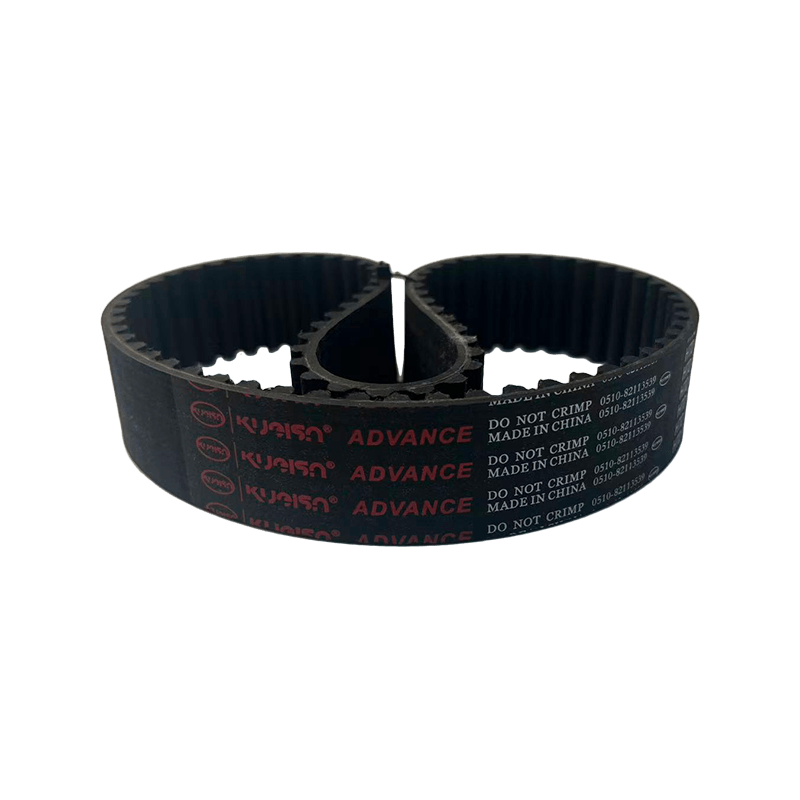
Rubber timing belts — most commonly made from neoprene (polychloroprene) — are constructed by bonding a rubber compound around a tensile cord, typically fiberglass, and then molding the tooth profile into the inner face. The result is a belt that is inherently flexible, absorbs vibration well, and can be manufactured in continuous lengths with consistent tooth geometry. The rubber compound can be compounded with various additives to improve oil resistance, heat tolerance, or static dissipation.
Polyurethane belts take a fundamentally different manufacturing approach. Liquid polyurethane is cast or extruded around a steel or aramid (Kevlar) tensile cord and then precision-molded into the desired tooth profile. Because polyurethane is a thermoplastic elastomer rather than a vulcanized rubber, the tooth geometry can be held to much tighter tolerances. Steel-cord variants are produced as open-ended strip and cut or welded to length, which means custom belt lengths are straightforward to produce without tooling a specific mold.
These structural differences ripple through every aspect of performance — stiffness, wear rate, chemical compatibility, and operating temperature range.
Wear Resistance and Surface Durability
Polyurethane is significantly harder than neoprene. On the Shore A hardness scale, industrial neoprene belts typically fall in the 60–75 range, while cast polyurethane used in timing belt production commonly lands between 85 and 95. That additional hardness translates directly into abrasion resistance — the tooth faces on a polyurethane belt wear at a fraction of the rate of a comparable rubber belt under the same load cycle.
In practice, this matters most in applications where the belt reverses direction frequently, operates at high cycle rates, or runs against pulleys with slightly imperfect surface finishes. Packaging machinery, labeling equipment, and pick-and-place systems often accumulate tens of millions of tooth-mesh cycles per year. Over that kind of operating life, the wear differential between polyurethane and rubber becomes substantial — and shows up clearly in maintenance records.
Rubber belts recover ground in applications where surface hardness works against performance. In drives that experience significant shock loading or impact — press feeders, for example — the softer rubber compound absorbs energy that a stiffer polyurethane belt would transmit directly into the tensile cord and pulley teeth. Under repeated high-impact conditions, a harder belt can actually fail faster because it cannot dampen the peak load spikes.
Chemical and Environmental Compatibility
This is where the two materials diverge most sharply, and where material selection mistakes are most costly. Neoprene has reasonable resistance to oil and mild hydrocarbons, which is why it has been used in automotive and general industrial drives for decades. It handles intermittent oil splash adequately in most factory environments. What it does not handle well is prolonged immersion in oils, exposure to ozone, or contact with strong solvents and cleaning agents. Over time, these exposures cause the neoprene to swell, soften, and lose dimensional stability — a problem that shows up as tooth pitch distortion and eventual belt slip.
Polyurethane is broadly more resistant to oils, fuels, and a wide range of industrial chemicals. It resists ozone degradation without requiring antiozonant additives, and its dimensional stability under chemical exposure is considerably better than neoprene's. In automotive assembly lines, where belts may be exposed to cutting fluids and lubricant mist, polyurethane is the standard choice for exactly this reason.
However, polyurethane has its own chemical vulnerabilities. It degrades in contact with hot water, steam, and strong acids or bases. In applications involving steam cleaning, high-pressure washdowns with alkaline detergents, or direct water immersion, polyurethane belts can hydrolyze — the polymer chains break down, the belt surface becomes tacky, and structural integrity deteriorates. Neoprene or specialized elastomer compounds perform significantly better in those conditions.
Temperature Range and Thermal Behavior
Standard neoprene timing belts are rated for continuous operation in a range of roughly -30°C to +80°C. Within that window, the material remains flexible and maintains its mechanical properties reliably. Beyond +80°C, neoprene begins to soften and the adhesion between the belt body and tensile cord deteriorates. At sustained temperatures above 100°C, belt life drops sharply. Low-temperature performance is actually one of neoprene's advantages — it stays flexible down to -30°C without becoming brittle, which matters in cold-storage and outdoor applications in northern climates.
Polyurethane operates effectively across a narrower temperature range. Most standard formulations are rated to approximately -20°C at the low end, and the upper limit for continuous operation is typically +70°C to +90°C depending on the specific compound. At low temperatures, polyurethane hardens more aggressively than neoprene and can become brittle, increasing the risk of cracking during startup if the belt has been sitting cold. At elevated temperatures, thermal cycling accelerates the hydrolysis process mentioned earlier, particularly in humid environments.
For high-temperature applications — conveyors in drying ovens, belts near heat-generating processing equipment — neither standard material may be adequate. Specialty compounds including EPDM-based belts or high-temperature polyurethane formulations extend the upper limit, but these are application-specific products that require direct consultation with the belt manufacturer.
Dimensional Precision and Positioning Accuracy
Polyurethane's manufacturing process allows it to hold tighter dimensional tolerances than molded rubber. Tooth pitch variation across a long belt is smaller, and the tooth profile geometry stays more consistent from one end to the other. In linear positioning systems — CNC axis drives, medical imaging equipment, semiconductor handling — this precision directly affects positioning repeatability. A rubber belt with slightly variable pitch will introduce a cyclical positioning error that repeats with each belt revolution, a phenomenon that shows up as a sinusoidal deviation in high-resolution measurement systems.
Steel-cord polyurethane belts take this further. Steel has near-zero elongation under load, which means the effective pitch of the drive remains consistent even as load fluctuates. Aramid-cord versions offer slightly more flexibility with only marginally higher elongation. For applications where positional accuracy is measured in hundredths of a millimeter, steel-cord polyurethane is effectively the only choice.
Rubber belts with fiberglass tensile cords do elongate more under load and temperature variation. That elongation is predictable and manageable in most power transmission applications where exact positioning is not the priority. For conveying and driving applications where some compliance is acceptable, the difference is functionally irrelevant.
Choosing Based on What the Application Actually Demands
A food processing line running washdown cycles three times per day needs a neoprene or specialty belt, not polyurethane. A servo-driven linear axis in an electronics assembly machine needs steel-cord polyurethane, not rubber. A general-purpose conveyor drive in a moderately clean factory can run either material successfully — and in that case, cost and availability will likely be the deciding factors.
The mistake to avoid is treating one material as universally superior. Polyurethane costs more, which leads some operations to standardize on rubber wherever possible. Others default to polyurethane assuming it is always the higher-performance option, then encounter hydrolysis failures in wet environments that a neoprene belt would have handled without issue. Match the material to the operating conditions — temperature, chemistry, precision requirements, and load character — and either material will deliver a long, reliable service life.


Contact
-

+86-510-82113539
Shirley: +86-18906170683
Got questions? Call us 24/7 -

[email protected]
Contact us now for a quote -

No.99 Fu Rong Zhong San Rd, Xishan District Economic and Technological Development Zones Wuxi City, Jiangsu, China
Copyright © Wuxi KUEISN Transmission Equipment Co.,Ltd.All Rights Reserved. OEM Industrial Timing Belt and Synchronous Pulley Manufacturer
