


 English
 Português
 Indonesia
Submit feedback
Timing Belts Width: Standard Dimensions, Calculation & Selection Guide
Specify a timing belt pitch and length, and most engineers will nod and move on. Mention belt width, and the room goes quiet. Width is consistently the most under-specified dimension in synchronous belt drive design — yet it is the single variable that determines how much power the belt can actually carry. Get it wrong in one direction and the belt slips or shreds under load. Go too wide without checking the mating pulley, and the flange geometry fails entirely.
This guide covers standard timing belt width dimensions across all major profiles, the engineering logic behind width and torque capacity, a practical calculation walkthrough, and application-specific selection strategies for industrial drive systems.
Belt Width Is Not Just a Dimension — It's a Power Decision
Every timing belt profile has a defined reference width. Manufacturers publish power ratings at that reference width. But the actual width you specify scales the belt's transmission capacity up or down in direct proportion — wider belts engage more tooth contact area, distribute load across a greater cross-section of the tensile cord, and handle higher effective tension without exceeding the shear limit of individual teeth.
Belt width affects three things simultaneously: load capacity, tensile strength, and pulley compatibility. A belt running at 60% of its rated capacity on a correctly matched pulley width will outlast one running at 90% capacity — not because the belt is "better," but because thermal fatigue, cord stress, and tooth shear all scale with the ratio of actual load to rated load. Width is the primary lever for adjusting that ratio without redesigning the entire drive.
The practical consequence: specifying belt width is not a lookup step. It is a calculation that begins with your design power requirements and ends with a standard width that satisfies a set of geometric and load conditions.
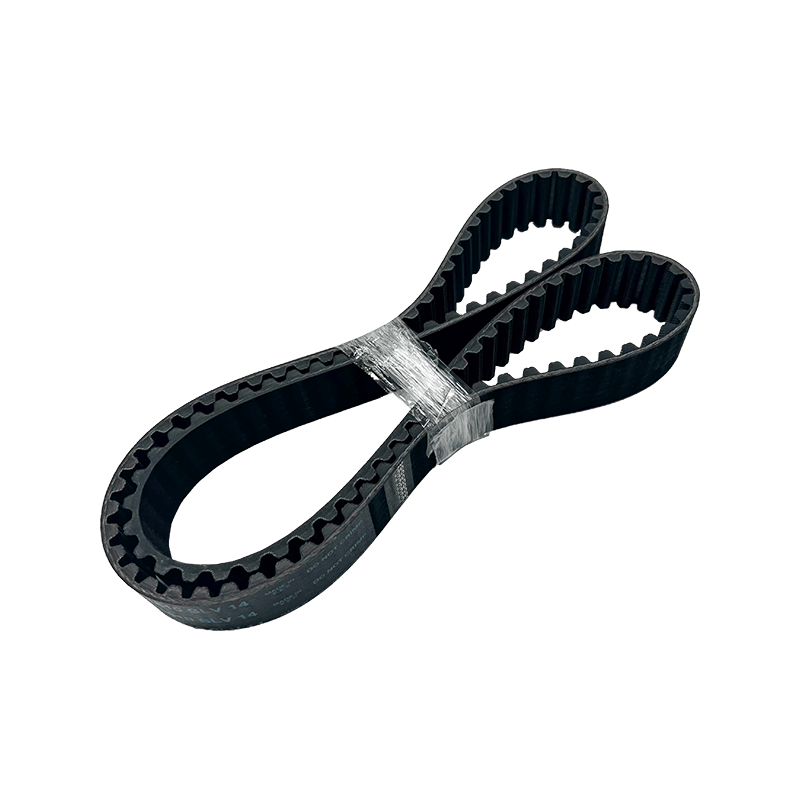
Standard Timing Belt Widths by Profile Type
Timing belt widths are standardized along two measurement systems: inch-based (used in classical MXL, XL, L, H, XH, XXH profiles) and metric (used in T, AT, HTD, and GT profiles). The table below lists nominal standard widths for the most common industrial profiles. In metric sizing, the final number in the belt designation directly represents the width in millimeters. In inch sizing, width codes appear as three-digit numbers representing hundredths of an inch.
How Width Affects Torque Capacity and Load Distribution
The physics here is straightforward, though the engineering implications are not always obvious. A timing belt transmits torque through the shear strength of its teeth. Each tooth engages a corresponding groove in the pulley, and the total transmitted force is the sum of contributions from all teeth currently in mesh. Wider belts have wider teeth — which means greater shear cross-section per tooth, and therefore higher allowable load per engaged tooth.
Beyond individual tooth shear, belt width also governs the tensile cord cross-section. Tensile cords run lengthwise through the belt and carry the bulk of the tension load. A wider belt contains more cords in parallel, multiplying effective tensile strength without requiring a change in pitch or belt length. Doubling belt width approximately doubles the allowable effective tension, which is why width scales proportionally in transmission capacity tables.
There is also a load distribution effect across the belt face. Narrower belts concentrate stress on a smaller section of each tooth flank. Under cyclic loading — which describes every rotating drive — this concentration accelerates fatigue. A moderately wider belt running the same power will exhibit significantly longer service life simply by distributing that cyclic stress across more material.
How to Calculate the Belt Width You Actually Need
Belt width selection begins with design power — not the nameplate power of the motor, but the corrected transmission load the belt must handle in service. Design power (Pd) is calculated by applying a service factor to the system's actual transmitted power, accounting for start-stop frequency, shock loading, and duty cycle characteristics.
Once Pd is established, the required belt width is determined by this relationship:
Bw' = Wp × (Pd / Ps) × (1 / Km)
Where Wp is the reference belt width for the chosen profile, Ps is the reference transmission capacity at the operating speed and small-pulley tooth count (from the manufacturer's capacity table), and Km is the engagement correction coefficient based on the number of teeth in mesh. The result Bw' is then rounded up to the nearest standard width, and the selection is verified by confirming that the design power falls within the corrected capacity of that standard width.
Industry standards including ANSI RMA IP-24 and ISO 5299 synchronous belt dimensional specifications govern pitch length and width tolerances, providing the reference framework that manufacturers use to publish capacity tables. Always verify that the selected width is checked against both the length correction coefficient (KL) and the minimum number of teeth in mesh — systems where fewer than six teeth engage simultaneously require particular attention to width to compensate for reduced tooth engagement.
Matching Belt Width to Industrial Applications
Width requirements differ substantially across industrial application categories. Below are the practical selection strategies for the scenarios where timing belt width is most critical:
Robotics and AGVs
Articulated robot arms and automated guided vehicles typically use HTD 5M or 8M belts. Width selection here is driven by acceleration torque — the peak load during direction reversal — rather than steady-state power. Use the maximum instantaneous torque as the basis for Pd, and verify that the selected width remains within the rated tooth shear capacity at that peak. For AGV drive axles, 30 mm width in 8M pitch is a common starting point under moderate payloads; heavier platforms move to 50 mm or wider.
Linear Positioning and CNC Axes
CNC machine tool axes and precision linear stages prioritize stiffness over raw power capacity. A wider belt has higher longitudinal stiffness per unit length, which reduces positioning error under varying loads. For ball-screw replacement drives, 8M or 14M profiles in widths of 30–50 mm are standard. Increasing width improves repeatability at the cost of inertia — factor in the mass moment of the wider belt when tuning servo parameters.
Textile Machinery and High-Speed Drives
Spinning frames, looms, and winding machines run at sustained high speeds where heat generation and belt fatigue govern belt life. Narrower belts in T5 or T10 profiles — 16 to 25 mm — are common because they minimize centrifugal force and keep belt mass low. Thermal performance at speed matters more than peak torque capacity in these applications, so the width selection often ends up narrower than the raw power calculation would suggest.
Food Processing and Hygienic Conveying
Food-grade conveyor systems use PU (polyurethane) timing belts rather than rubber, and belt width is sized to match the product contact surface requirement of the conveyor — not just the drive load. The minimum width that satisfies the load calculation is then compared to the required product-support width, and the larger value governs. T5 and T10 profiles in widths of 25–50 mm cover most food-handling conveyor drives in the light-to-medium range.
Agricultural and Outdoor Machinery
Harvester drives, seeder transmission systems, and outdoor equipment run under highly variable load conditions — seasonal temperature swings, contamination, and irregular shock loads. HTD profiles with extra-wide belts (50–85 mm in 8M or 14M pitch) provide the margin needed to handle load variation without frequent replacement. Belt width in these applications should incorporate a service factor of at least 1.5 over the peak calculated load.
Mistakes That Lead to Wrong Belt Width Selection
Three errors account for the vast majority of field failures traced back to incorrect belt width:
Specifying Width Without Calculating Design Power First
Matching an existing belt by dimension — pitch, length, width — without verifying that the width is adequate for the actual load is the most common mistake. Applications evolve: motors get upgraded, duty cycles intensify, and loads increase. A belt that was "fine" at installation can be undersized six months later when the process has changed. Always recalculate design power before confirming a replacement width.
Mismatching Belt Width to Pulley Face Width
The belt width must not exceed the usable face width of the mating pulley. A belt that overhangs the pulley flange will experience uneven load distribution across its width, with the unsupported edge running under concentrated stress. This leads to edge cracking and premature delamination — failures that look like material defects but are caused by geometry mismatch. Confirm pulley face width before finalizing belt width, and maintain at least 2–3 mm of clearance inside the flange on each side.
Ignoring Teeth-in-Mesh When Small Pulleys Are Used
Published capacity tables assume a minimum number of teeth in mesh — typically six or more. Drives with small-diameter pulleys or short center distances may only engage four or five teeth, which reduces the effective tooth shear capacity below the tabled value. In these cases, width must be increased beyond what the basic formula yields to compensate for the engagement deficit. Always verify the teeth-in-mesh count as part of the width confirmation step.
Custom Belt Widths for Non-Standard Needs
Standard catalog widths cover most applications, but industrial OEM programs frequently require widths that fall between standard increments — or that match a legacy machine's original specification where the standard has since been revised. In these cases, custom belt widths are cut from stock belt sleeving, which is manufactured as a continuous sleeve in the desired profile and pitch, then slit to the required width with precision cutting equipment.
Custom widths carry the same tensile cord configuration and tooth geometry as the equivalent standard width range, so the capacity calculation applies directly — the only constraint is the maximum sleeve width available for the chosen profile. For production OEM volumes, custom widths are supplied on multi-roll quantities with width tolerances maintained to the applicable ISO standard.
For sourcing custom-width industrial timing belts, synchronous pulleys, and complete drive system components, KUEISN's full range of industrial synchronous belts and pulleys covers standard and custom configurations across rubber and PU belt profiles, with OEM and ODM support for specialized width requirements.


Contact
-

+86-510-82113539
Shirley: +86-18906170683
Got questions? Call us 24/7 -

[email protected]
Contact us now for a quote -

No.99 Fu Rong Zhong San Rd, Xishan District Economic and Technological Development Zones Wuxi City, Jiangsu, China
Copyright © Wuxi KUEISN Transmission Equipment Co.,Ltd.All Rights Reserved. OEM Industrial Timing Belt and Synchronous Pulley Manufacturer
