


 English
 Português
 Indonesia
Submit feedback
AGV Drive System Explained: Why Timing Belts Are the Preferred Choice
The global AGV market was valued at over USD 5.75 billion in 2025 and is projected to surpass USD 11.5 billion by 2033. Behind that growth is a quieter engineering question that every AGV manufacturer eventually confronts: what drives the wheels, and how reliably can it do so around the clock without human intervention? The answer, across the industry, has converged on the timing belt — and that convergence is not accidental.
Why AGV Drive Systems Demand More Than Generic Power Transmission
A forklift operated by a human can tolerate a little vibration, a brief positioning error, or a quick stop for lubrication. An AGV cannot. Running 20 hours a day, navigating shared spaces with human workers, and interfacing precisely with conveyors, palletizers, and pick stations, an AGV drive system is held to a fundamentally different standard.
Three requirements define that standard. First, repeatable positioning accuracy: the drive must deliver the vehicle to the same coordinates, time after time, without accumulating error. Second, zero unplanned downtime: maintenance that requires stopping the vehicle, applying lubricant, or re-tensioning components is a productivity loss that compounds across a fleet. Third, clean operation: in food, pharmaceutical, and semiconductor facilities, any drive system that weeps oil or sheds metal particles is disqualifying.
synchronous belts for AGV and automation systems address all three requirements simultaneously — which is precisely why they have become the default choice for engineers designing modern AGV drivetrains.
How Timing Belts Work in an AGV Drive System
A timing belt — also called a synchronous belt — is a toothed belt that meshes with matching grooves on its drive and driven pulleys. Unlike a V-belt or flat belt, which transmits torque through friction, the timing belt transmits through positive engagement: each tooth locks mechanically into a pulley groove, so no slip is physically possible.
In an AGV drivetrain, this matters enormously. The motor turns a drive pulley by a precise number of teeth; the belt relays that rotation to the wheel shaft without any lost motion. Closed-loop servo controllers can read encoder feedback and command exact displacements because the mechanical path between motor output and wheel is completely deterministic. There is no elastic creep, no friction-dependent variation, no elongation under load that the control system needs to compensate for.
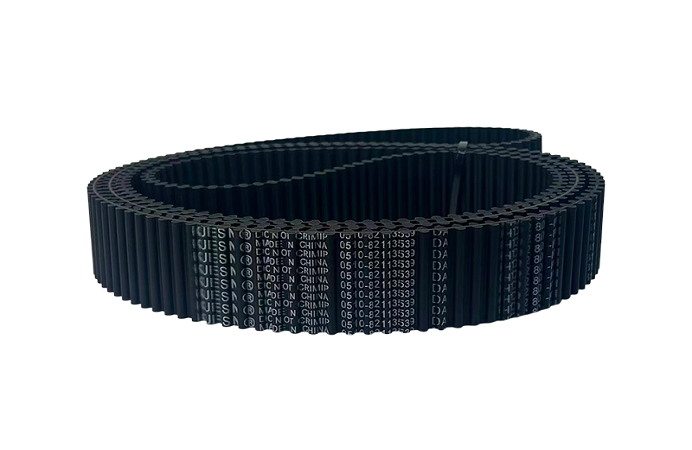
Modern timing belts used in AGV applications typically feature curvilinear or modified curvilinear tooth profiles — designs that distribute contact stress more evenly across each tooth, reduce noise during high-speed engagement, and extend fatigue life compared to older trapezoidal profiles. The tensile members — fiberglass, aramid, or steel cord depending on load requirements — run the full length of the belt and carry the majority of the tension, keeping the belt dimensionally stable over its entire service life.
Timing Belts vs. Chain Drives vs. V-Belts: A Direct Comparison
Understanding why timing belts dominate AGV applications is clearest when set against the alternatives engineers typically consider.
Chain drives offer high tensile strength and handle shock loads well — advantages that matter in heavy industrial conveyor applications. But chains require regular lubrication, stretch as joints wear, generate audible running noise, and shed metal particles. Re-tensioning intervals shorten as the chain elongates, adding maintenance overhead. In a fleet of 50 AGVs running continuously, the cumulative maintenance burden of chain-based drivetrains is substantial. More critically, the lubricant required creates a contamination risk that rules chains out entirely in cleanroom, food, and pharmaceutical environments.
V-belts are inexpensive and absorb vibration effectively, but they rely on friction for power transmission. That means slip is inherent to their operation — acceptable in fan drives and compressors, incompatible with the positioning demands of an AGV. V-belts also require higher pre-tension to maintain grip, which increases bearing loads and accelerates wear. Efficiency under load is typically in the 90–96% range, and it degrades as the belt ages and stretches.
Timing belts eliminate slip by design. Drive efficiency runs consistently at 95–98% across the belt's service life, with no degradation as the belt ages, because power transfer depends on tooth geometry rather than surface friction. Noise levels are significantly lower than chains — critical in facilities where AGVs share space with office workers or in noise-sensitive manufacturing lines. And because no lubrication is required at any point in the drivetrain, the system remains clean from installation to end-of-life.
Five Reasons Timing Belts Are the Preferred Choice for AGVs
1. Sub-Millimeter Positioning Accuracy
High-quality synchronous belt drives deliver repeat positioning accuracy within ±0.02 mm. For an AGV that must dock at a charging station, align with a conveyor transfer point, or present a load to a robotic arm, that level of consistency is not a premium feature — it is a functional requirement. Because timing belts introduce zero slip and negligible elastic deformation under normal operating loads, the relationship between motor encoder counts and actual wheel travel remains constant and predictable over millions of cycles.
2. Lubrication-Free, Clean Operation
No oil. No grease. No scheduled lubrication intervals. This single characteristic eliminates an entire category of maintenance tasks and, more importantly, an entire category of contamination risk. In food processing facilities, pharmaceutical warehouses, and semiconductor fabs — three of the fastest-growing segments for AGV deployment — a drive system that cannot guarantee oil-free operation simply does not qualify. Timing belts meet that requirement inherently, not through add-on sealing or containment systems.
3. Low Noise and Vibration
Chain drives generate impact noise at every roller-sprocket engagement. At high speeds, this noise becomes a continuous rattle that propagates through the vehicle frame and into the facility floor. Timing belts, by contrast, engage their pulleys through elastomeric tooth profiles that absorb impact, producing a smooth, low-frequency transmission with minimal airborne noise. This matters operationally: AGVs working near human operators, in hospitals, or in facilities with acoustic requirements can run timing belt drives without triggering noise complaints or safety concerns.
4. Extended Service Life and Low Maintenance Costs
A properly specified timing belt in an AGV application typically delivers more than 20,000 hours of service before replacement is needed — equivalent to several years of continuous operation. There is no re-tensioning required, because timing belt length remains dimensionally stable throughout its service life. There are no lubrication intervals, no chain-stretch measurements, no sprocket inspections for wear. The result is a dramatically lower total cost of ownership compared to chain or V-belt alternatives, particularly across a multi-vehicle fleet where maintenance labor costs accumulate quickly.
5. High Power Density in a Compact, Lightweight Package
AGV designers work within tight dimensional constraints. The drive system must fit within a low-profile chassis, leave room for batteries, sensors, and control hardware, and still deliver sufficient torque to accelerate and decelerate the vehicle and its payload smoothly. Timing belts deliver a high power-to-weight ratio: a narrower, lighter belt can transmit the same load as a significantly heavier chain assembly. This weight reduction improves battery efficiency, extends run time between charges, and allows more agile vehicle dynamics — all compounding benefits for fleet economics.
Selecting the Right Timing Belt for Your AGV Application
Not all timing belts perform equally in AGV environments. The choice of material and tooth profile has a direct impact on service life, positioning accuracy, and environmental compatibility.
Rubber timing belts — typically neoprene or EPDM with fiberglass or aramid tensile cords — are the standard choice for general industrial AGV applications. They offer good flexibility, handle moderate temperature ranges well, and are cost-effective for high-volume production. Nylon-coated tooth faces reduce wear at the belt-pulley interface and extend service life under continuous cycling. rubber timing belts for industrial AGV drives cover the majority of warehouse and manufacturing deployment scenarios.
Polyurethane timing belts bring additional properties that matter in demanding AGV environments: higher abrasion resistance, better chemical resistance, and the ability to operate across a wider temperature range. PU belts are also dimensionally more stable than rubber variants, making them the preferred choice where sub-millimeter positioning must be maintained across temperature cycling — common in cold storage warehouses or outdoor AGV applications. polyurethane timing belts for precision AGV positioning are also the standard specification for cleanroom and food-grade deployments, where particle generation must be minimized.
On tooth profile, the modified curvilinear designs — AT, HTD, and GT profiles — outperform older trapezoidal teeth in AGV drivetrains. Their deeper, curved tooth geometry distributes load more evenly, reduces the risk of tooth skip under dynamic acceleration loads, and operates more quietly at the speeds typical of AGV wheel drives. For the pulley side of the equation, precision timing pulleys matched to your belt specification are equally critical: belt and pulley must be designed as a system, not sourced independently, to achieve the positioning accuracy and service life that AGV applications require.
Practical selection parameters to confirm before specifying a belt include peak torque at startup (which often exceeds running torque by 2–3x in servo-driven systems), the center distance between drive and driven shafts, operating temperature range, and whether the vehicle will operate in environments with oil mist, cleaning chemicals, or elevated humidity.
Putting It All Together
The timing belt's dominance in AGV drive systems is the outcome of a straightforward engineering calculation: the performance requirements of modern automated guided vehicles — precise positioning, continuous duty cycles, clean environments, minimal maintenance — align almost exactly with the inherent characteristics of synchronous belt drives. Chain drives offer brute strength but demand lubrication, re-tensioning, and tolerate noise. V-belts are economical but slip-dependent and imprecise. Timing belts deliver accuracy, cleanliness, and long service life without compromise.
As AGV deployments scale from single vehicles to coordinated fleets of dozens or hundreds of units, the operational advantages of timing belts — particularly the elimination of lubrication-related downtime and the extended service intervals — translate directly into measurable cost savings and higher fleet availability.
For manufacturers and system integrators who need belts specified and built to AGV drivetrain requirements, custom OEM and ODM timing belt solutions engineered for your application ensure that belt geometry, material, tensile cord specification, and tooth profile are matched to your vehicle's actual load cycle, environment, and accuracy requirements — not adapted from a catalog standard.


Contact
-

+86-510-82113539
Shirley: +86-18906170683
Got questions? Call us 24/7 -

[email protected]
Contact us now for a quote -

No.99 Fu Rong Zhong San Rd, Xishan District Economic and Technological Development Zones Wuxi City, Jiangsu, China
Copyright © Wuxi KUEISN Transmission Equipment Co.,Ltd.All Rights Reserved. OEM Industrial Timing Belt and Synchronous Pulley Manufacturer
